.png?width=201&height=201&name=Maintenance%20(Videoannonce%20%E2%80%93%20LinkedIn).png)

How to Fix Flight School Operations Bottlenecks in 2026
 Amalie Rasmussen
·
12 minute read
Amalie Rasmussen
·
12 minute read
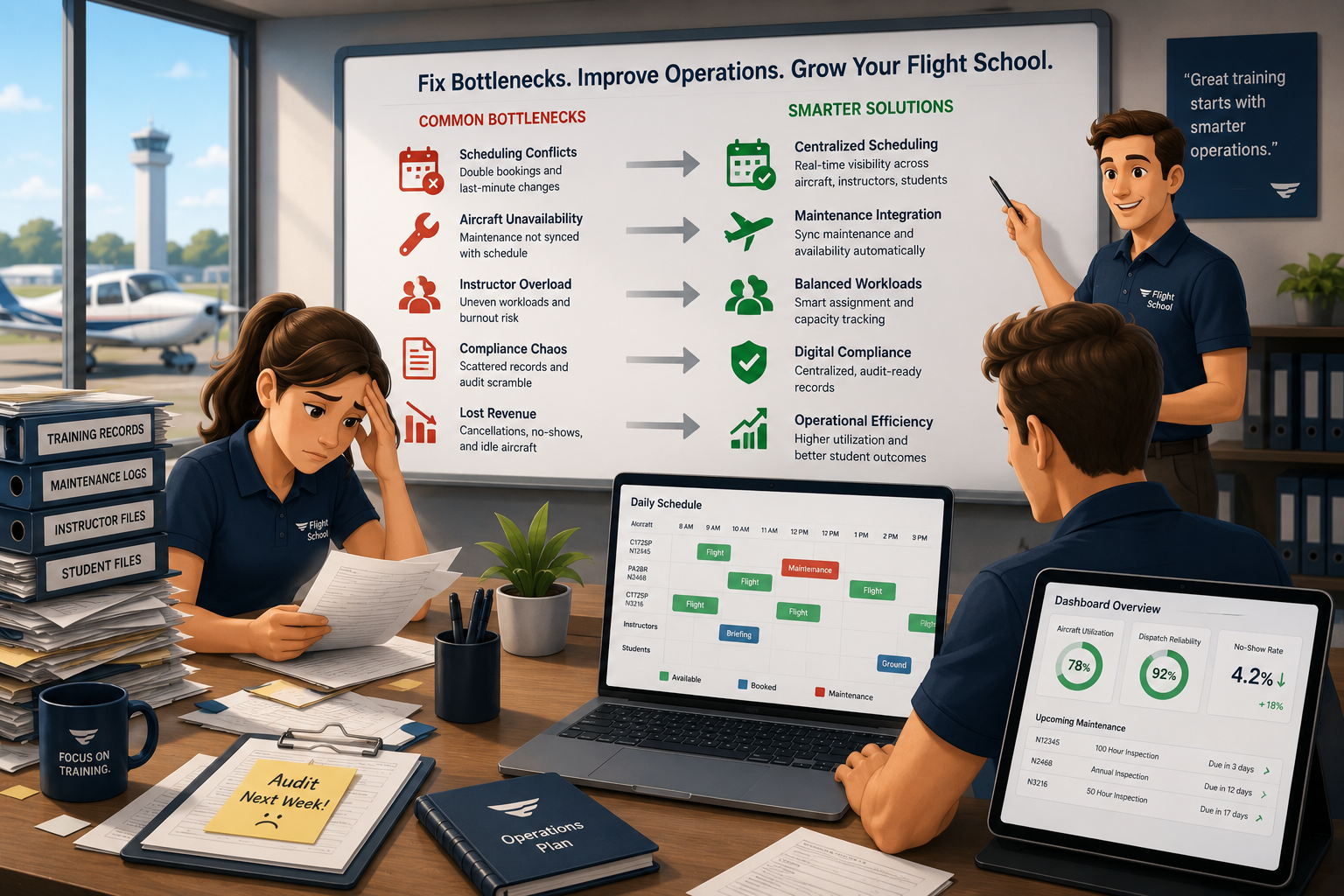
Running a flight school means coordinating aircraft availability, instructor schedules, student progression, maintenance windows, and regulatory compliance - all at once. When any of these elements fall out of sync, bottlenecks form quickly. Lessons get cancelled, aircraft sit idle, and audit prep becomes a scramble.
FlightLogger helps flight training organizations identify and eliminate these operational friction points through centralized digital management. This guide walks you through the most common bottlenecks in flight school operations and shows you exactly how to address each one, from training scheduling to compliance documentation.
You'll learn practical steps for diagnosing inefficiencies, implementing digital workflows, and building a scalable operational foundation that supports both your current students and future growth.
Key Takeaways: How to Fix Flight School Operations Bottlenecks
- Scheduling bottlenecks often stem from aircraft, instructors, and maintenance running in disconnected systems with no unified view.
- Audit readiness improves dramatically when you replace fragmented recordkeeping with centralized, timestamped digital training logs.
- Student progression tracking needs to be visible to both instructors and administrators to catch at-risk students early.
- FlightLogger centralizes scheduling, compliance, and student management into one platform built specifically for flight training organizations.
- Successful digital adoption requires proper onboarding, staff training, and gradual migration rather than an abrupt overnight switch.
What Are the Most Common Flight School Operations Bottlenecks?
Bottlenecks in flight training operations typically emerge in five core areas: scheduling, aircraft availability, instructor coordination, student progression tracking, and compliance documentation. Understanding where your school's pain points originate is the first step toward fixing them.
Scheduling conflicts occur when aircraft bookings, instructor availability, and student lesson sequences don't communicate with each other. A single weather delay or maintenance issue can cascade through your entire day.
Compliance bottlenecks appear when documentation lives in multiple locations—some digital, some paper-based—making audit preparation time-consuming and stressful. According to AOPA's recordkeeping guidance, instructors must maintain training records for at least three years, and those records need to be readily accessible.
Why Does Scheduling Cause So Many Flight Training Challenges?
Scheduling in flight training is fundamentally more complex than in most other industries. You're coordinating multiple interdependent resources: aircraft, instructors, students, classrooms, simulators, and maintenance windows. Each resource has its own constraints.
Aircraft have flight hour limits before mandatory maintenance checks. Instructors have duty-time restrictions and personal schedules. Students may have day jobs or school commitments that limit their availability to narrow windows.
When these schedules exist in separate systems—or worse, on paper calendars and whiteboards—conflicts become invisible until someone shows up for a lesson and discovers the aircraft is in maintenance. Dynamic rescheduling becomes nearly impossible when you can't see all resources in one place.
How Resource Conflicts Lead to Lost Revenue
Every cancelled lesson represents lost revenue and delayed student progression. If a student books a flight lesson but the aircraft isn't available, you've lost that slot entirely. Multiply this across dozens of students and multiple aircraft, and the revenue impact adds up fast.
The hidden cost is even greater: students who experience repeated cancellations lose momentum. Their training stretches longer, their motivation drops, and some may leave for competitors who can offer more reliable scheduling.
Why Manual Coordination Creates Scheduling Risks
Manual scheduling processes rely on individual memory and communication. When an instructor calls in sick, someone must manually contact affected students, find replacement instructors, and update all the relevant records.
This manual coordination works at small scales, but breaks down as your operation grows. The more students, instructors, and aircraft you manage, the more likely that critical information gets lost in handoffs or simply forgotten.
How Do You Identify Scheduling Inefficiencies in Your Flight School?
Start by tracking your cancellation rate and the reasons behind each cancelled lesson. If aircraft maintenance is a frequent cause, your scheduling system may not be synced with your maintenance tracking.
Look at your aircraft utilization rates. If some aircraft consistently sit idle while others are overbooked, your scheduling process isn't optimizing fleet usage. A well-run flight school should see relatively even utilization across comparable aircraft.
Ask your instructors how much time they spend on scheduling-related tasks. If they're spending significant hours coordinating lessons, calling students, or checking aircraft availability, that's time not spent teaching.
Warning Signs Your Scheduling System Is Creating Bottlenecks
Frequent last-minute cancellations are the clearest warning sign. If students regularly show up for lessons only to learn the aircraft or instructor isn't available, your scheduling system has visibility gaps.
Another warning sign: instructors or dispatchers maintaining their own shadow calendars. When people don't trust the official system, they create backup processes—which only increases the chance of conflicts.
High instructor turnover can also indicate scheduling problems. Young instructors building hours toward airline careers will leave sooner if scheduling chaos makes their jobs frustrating.
What Makes Compliance Documentation a Major Bottleneck?
Regulatory compliance in flight training requires meticulous documentation. FAA Part 141 schools must record every student training session. EASA ATOs need to track competency-based assessments and maintain audit-ready records for their National Aviation Authority.
When these records live in filing cabinets, instructor logbooks, and scattered files, audit preparation becomes a major project. Staff spend days or weeks pulling records, cross-referencing documents, and filling gaps before an inspector arrives.
Research from Constructor Tech's 2025 analysis of European ATOs found that organizations with fragmented IT systems consistently showed documentation gaps, delayed compliance evidence, and incomplete training records during audits.
The Real Cost of Poor Recordkeeping
Poor recordkeeping creates risk beyond audit stress. If you can't demonstrate that a student completed required training sequences, you may face certification issues. If instructor qualification records are incomplete, you may discover compliance gaps only when an inspector asks for proof.
The time cost is substantial too. Instructors who spend hours on compliance paperwork have less time for student instruction. Administrators who scramble before audits have less time for operations improvement.
Why Audit Readiness Should Be Ongoing, Not Periodic
The most efficient flight schools treat compliance as a daily practice, not a pre-audit scramble. When records are captured digitally at the point of training—with timestamps, digital signatures, and automatic validation—audit prep becomes a matter of generating reports rather than reconstructing history.
This shift requires moving from reactive compliance (fixing records before audits) to proactive compliance (preventing gaps from forming in the first place). Digital systems that validate records in real-time make this transition possible.
How Does Student Progression Tracking Become a Bottleneck?
Student progression tracking affects both training quality and operational efficiency. When instructors can't easily see what a student has completed and where they are in their course, lesson planning becomes guesswork.
Inconsistent grading across instructors is a related problem. If different instructors use different standards or record grades in different formats, it becomes difficult to assess whether a student is truly ready for their next stage check or checkride.
At-risk students often go unidentified until they've already fallen significantly behind. By the time someone notices a student hasn't flown in three weeks, re-engagement becomes much harder.
Signs Your Student Tracking Creates Delays
If students are frequently surprised to learn they're behind schedule, your tracking system isn't giving them adequate visibility into their own progress.
If instructors spend time at the start of each lesson reviewing what was covered previously—because records aren't clear—you're losing valuable training time to administrative catch-up.
If your average time to completion exceeds industry norms for your certificate or rating programs, fragmented progression tracking may be a contributing factor.
Why Centralized Student Records Improve Completion Rates
When student records are centralized and visible to all instructors, continuity improves. An instructor covering for a sick colleague can quickly review the student's history and pick up exactly where they left off.
Students themselves benefit from clear visibility into their progress. When they can see exactly what they've completed and what remains, they stay more engaged and motivated.
Administrators benefit too. Early warning indicators—like a student who hasn't scheduled a lesson in two weeks—can trigger proactive outreach before the student disengages entirely.
How Can Digital Tools Address Flight Training Challenges?
Digital flight training management systems address bottlenecks by creating a single source of truth for scheduling, compliance, and student records. When all data lives in one connected system, conflicts become visible and coordination becomes automatic.
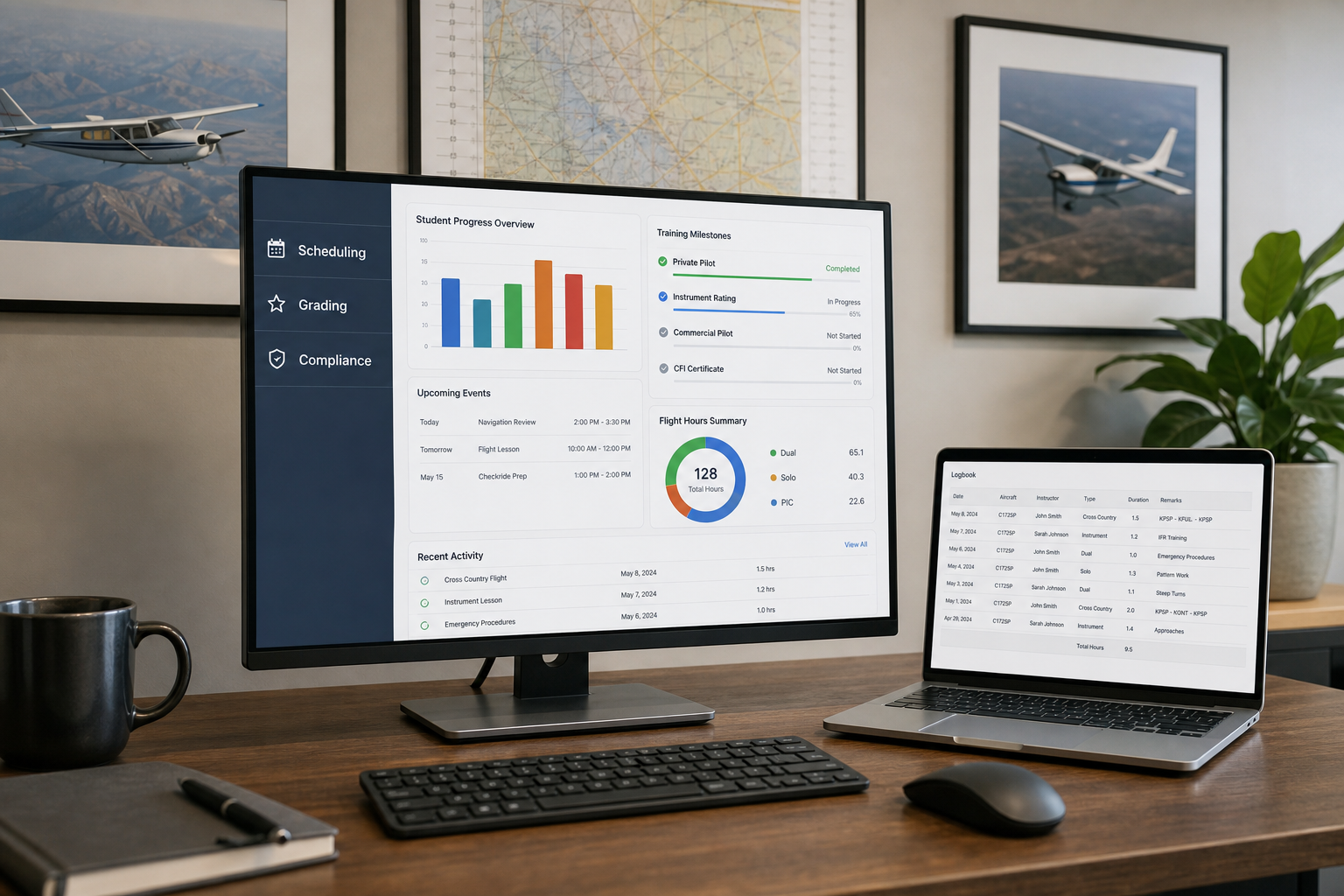
FlightLogger gives flight schools this centralized visibility across scheduling, maintenance, student progression, and compliance documentation. The platform was built specifically for aviation training operations, which means it understands the unique constraints of aircraft availability, instructor duty times, and regulatory requirements.
The key is integration. A scheduling system that doesn't know about maintenance windows will create conflicts. A student tracking system that doesn't connect to scheduling will miss utilization insights. Only an integrated platform can eliminate the information gaps that create bottlenecks.
Key Features That Eliminate Scheduling Bottlenecks
Real-time visibility into aircraft, instructor, and student availability prevents double-bookings and resource conflicts. When you can see your entire operation in one view, scheduling becomes straightforward.
Automated notifications reduce no-shows by reminding students of upcoming lessons and alerting them immediately when schedules change.
Integration with maintenance tracking ensures aircraft aren't scheduled during maintenance windows. When maintenance updates automatically reflect in the scheduling system, conflicts disappear.
Key Features That Streamline Compliance
Digital training logs with timestamps and digital signatures create audit-ready records at the point of training. There's no need to reconstruct documentation later because the system captures everything in real-time.
Automated expiry tracking for instructor certifications, medical certificates, and aircraft airworthiness documents prevents compliance gaps from developing unnoticed.
Built-in reporting generates the documentation auditors need without manual compilation. When an inspector asks for training records, you can produce them in minutes rather than days.
How Do You Implement Digital Training Scheduling Successfully?
Successful implementation starts with clear goals. Identify the specific bottlenecks you're trying to solve before selecting a platform. A tool that excels at scheduling may not address your compliance needs, and vice versa.
Migration planning is critical. Moving from paper-based or fragmented digital systems requires careful data transfer and validation. Rushing this process creates errors that undermine trust in the new system.
Staff training makes or breaks adoption. Even the best platform fails if your instructors and dispatchers don't know how to use it effectively. Invest in proper onboarding and ongoing support.
Step-by-Step Implementation Process
Begin with an audit of your current processes. Document exactly how scheduling, compliance, and student tracking work today—including the workarounds and shadow systems that have developed over time.
Next, configure the new system to match your operational needs. Flight schools vary significantly in structure, regulatory environment, and workflow preferences. A good platform will adapt to your processes rather than forcing you into a rigid template.
Run a parallel period where both old and new systems operate simultaneously. This allows staff to build confidence in the new system while maintaining the safety net of familiar processes.
Finally, phase out legacy systems once staff are comfortable and data integrity is confirmed. Set a clear cutover date and stick to it—indefinite parallel operation creates confusion.
Common Implementation Mistakes to Avoid
Underestimating training time is the most common mistake. Staff need time to learn new workflows, and productivity typically dips during the transition before recovering and improving.
Migrating bad data perpetuates problems. Use the implementation as an opportunity to clean and validate your records rather than simply copying existing errors into the new system.
Ignoring change resistance leads to adoption failure. Some staff will prefer familiar processes even when they're inefficient. Address concerns directly and demonstrate concrete benefits to build buy-in.
How Does FlightLogger Help Optimize Pilot Training Management?
FlightLogger centralizes the core functions that drive flight school operations: scheduling, aircraft and maintenance management, student progression tracking, grading, and compliance documentation. The platform serves over 210 flight schools across more than 50 countries.
The system supports both FAA and EASA regulatory environments, with configurable workflows that adapt to your specific compliance requirements. Multi-campus operations can manage all locations from a single platform while maintaining appropriate regional configurations.
Flight schools using FlightLogger have reported significant reductions in administrative overhead, with some organizations seeing up to 30% less time spent on compliance-related tasks. The platform's cloud-based architecture means staff and students can access information from anywhere, on any device.
How FlightLogger Reduces Administrative Overhead for Instructors
Instructors benefit from digital grading tools that capture assessments immediately after each lesson. No more paper grade sheets that need to be transcribed later—data enters the system once and flows through to student records automatically.
Scheduling visibility lets instructors see their upcoming lessons, student histories, and aircraft assignments in one place. Less time searching for information means more time focused on instruction.
Built-in compliance tracking alerts instructors when their own certifications approach expiry, preventing the surprise of discovering an expired rating right before a scheduled lesson.
How FlightLogger Improves Student Throughput
Smarter scheduling maximizes aircraft utilization, which means more available lesson slots for students. When aircraft downtime decreases, student progression accelerates.
Real-time progression tracking identifies at-risk students early, allowing proactive intervention before small delays become major setbacks.
Automated notifications reduce no-shows and keep students engaged with their training. When students know exactly where they stand and what comes next, they stay motivated to continue.
What Training Scheduling Best Practices Should You Follow?
Build buffer time into your schedule. Weather delays, maintenance discoveries, and lesson overruns happen regularly in flight training. Schedules without flexibility cascade small delays into major disruptions.
Standardize your scheduling rules. Define clear policies for minimum booking notice, cancellation windows, and no-show consequences. When everyone follows the same rules, the system works better for everyone.
Review utilization data regularly. Monthly analysis of aircraft usage, instructor hours, and cancellation patterns reveals trends that daily operations obscure.
How to Balance Aircraft Utilization and Maintenance Needs
Aircraft generate revenue when they fly, but maintenance keeps them safe and compliant. The tension between utilization and maintenance is real, and managing it well requires integrated scheduling.
Schedule maintenance during naturally low-demand periods when possible. If your school is quietest on Tuesday mornings, that's when routine inspections should happen.
Track Hobbs and Tach time carefully to anticipate maintenance needs. When you know an aircraft will hit its 100-hour inspection in three weeks, you can plan around it rather than reacting when it grounds unexpectedly.
How to Optimize Instructor Scheduling for Retention
Instructor scheduling directly affects retention. Young instructors building hours will leave sooner if scheduling practices frustrate them—inconsistent hours, frequent last-minute changes, or gaps that prevent them from reaching monthly targets.
Communicate schedules as far in advance as possible. Instructors with outside commitments (most of them) need predictability to plan their lives.
Distribute high-value lessons (those that build hours efficiently) fairly across your instructor team. Perceived favoritism in scheduling creates resentment and turnover.
How Do You Build an Audit-Ready Compliance System?
Audit readiness is the result of daily compliance practices, not pre-inspection preparation. The goal is a system where every required record is captured, timestamped, and accessible in real-time.
Define your documentation requirements clearly. What records do your regulatory authorities require? What retention periods apply? What format do inspectors expect?
Build compliance capture into your workflows. When instructors log a lesson, compliance data should be captured automatically—not as a separate task they might skip when busy.
Essential Compliance Documentation for Flight Schools
Training records form the core of flight school compliance. Every lesson must be documented with date, duration, content covered, and instructor sign-off.
Student progression records demonstrate that training followed approved syllabi and that students met prerequisites before advancing to subsequent stages.
Instructor qualification records prove that the people conducting training hold appropriate certifications for the instruction they deliver.
Aircraft maintenance records document airworthiness and regulatory compliance for each aircraft in your fleet.
How Digital Systems Make Audits Stress-Free
Digital compliance systems eliminate the scramble that precedes traditional audits. When inspectors arrive, you generate reports rather than searching through files.
Timestamped records with digital signatures demonstrate authenticity in ways that paper records cannot. There's no question about when a record was created or whether it might have been altered.
Centralized storage means nothing gets lost. Paper records in filing cabinets can be misfiled, damaged, or simply forgotten. Digital records remain searchable and accessible indefinitely.
How Can You Scale Flight School Operations Without Creating New Bottlenecks?
Growth creates operational stress. Adding students, aircraft, or locations multiplies the complexity of coordination. Systems that worked at smaller scale often break down as volume increases.
The key to scaling successfully is building your operational infrastructure before you need it. Implementing digital management systems when you're small and stable is far easier than doing so while simultaneously managing growth.
Multi-campus operations face particular challenges. Each location may have different aircraft, instructors, and even regulatory requirements. A centralized system that accommodates regional variation lets you maintain oversight without micromanaging each site.
Planning for Growth Before It Creates Problems
Project your growth trajectory and assess whether your current systems can handle it. If you expect to double enrollment in two years, can your scheduling system, your compliance processes, and your student tracking handle twice the volume?
Identify your current constraints. What limits your growth today—aircraft availability, instructor capacity, scheduling complexity, or something else? Address these constraints before they become bottlenecks.
Invest in systems that scale. The right platform should handle your current operation and your projected growth without requiring replacement.
Managing Multi-Location Flight Training Operations
Multi-location operations need centralized visibility with local autonomy. Headquarters needs to see the full picture; individual locations need the freedom to manage daily operations.
Standardize what matters for safety and compliance; allow flexibility for local preferences. The grading system should be consistent across locations; the exact weekly scheduling rhythm can vary.
Use shared resources wisely. If aircraft can move between locations based on demand, your scheduling system should facilitate that movement rather than treating each location as an isolated operation.
In Conclusion: Building a Bottleneck-Free Flight Training Operation
Flight school operations bottlenecks are predictable and addressable. Scheduling conflicts, compliance burdens, and student tracking gaps all stem from fragmented information and disconnected processes.
The solution is integration—bringing scheduling, compliance, maintenance, and student management into a single system that creates one source of truth for your entire operation. When information flows freely and everyone sees the same data, coordination becomes natural rather than effortful.
Start by diagnosing your specific bottlenecks. Track cancellation rates, audit prep time, and student completion metrics. Then address the root causes with appropriate tools and process changes.
FlightLogger offers flight training organizations a purpose-built platform for exactly this kind of operational integration. If you're ready to eliminate the bottlenecks holding your school back, consider how centralized digital management could change your daily operations.
FAQs about How to Fix Flight School Operations Bottlenecks
What causes most flight school scheduling conflicts?
Scheduling conflicts typically result from aircraft, instructors, and maintenance operating in separate systems without real-time synchronization. When resources aren't visible in one unified calendar, double-bookings and conflicts become inevitable.
FlightLogger solves this by integrating scheduling across all resources—aircraft, instructors, students, and maintenance—in a single platform with automatic conflict detection.
How long does it take to become audit-ready with digital compliance tools?
Most flight schools achieve audit readiness faster once digital compliance systems capture records at the point of training. Instead of weeks of preparation, generating audit documentation becomes a matter of running reports.
The transition period varies based on your current state, but FlightLogger customers typically see significant improvements in audit prep time after the first few months of use.
Can digital systems replace instructor logbooks for regulatory compliance?
Yes, in most jurisdictions. FAA regulations require pilots to maintain sufficient records—they don't mandate paper logbooks specifically. Digital records with proper timestamps and authentication meet regulatory requirements.
FlightLogger captures training records digitally with timestamps and digital signatures, creating documentation that satisfies both FAA and EASA compliance standards.
What's the biggest mistake flight schools make when implementing new software?
Underestimating the time needed for staff training and data migration is the most common mistake. Rushing implementation leads to poor adoption, data errors, and frustrated staff who revert to old processes.
Successful implementation requires dedicated onboarding, parallel operation periods, and ongoing support. FlightLogger includes dedicated onboarding and customer success support to ensure smooth transitions.
How do you measure whether operations improvements are working?
Track key metrics before and after changes: cancellation rates, aircraft utilization, average time to completion, and hours spent on compliance tasks. Improvement should be visible in these numbers within months.
FlightLogger gives you real-time visibility into operational metrics, making it easy to track improvements and identify areas needing further attention.
What features matter most for Part 141 flight school compliance?
Part 141 schools need training record documentation, stage check tracking, and 80% completion rate monitoring. The ability to demonstrate that training followed approved syllabi is critical during FAA surveillance inspections.
FlightLogger supports Part 141 requirements with structured training logs, progression tracking, and report generation that meets FAA documentation standards.