.png?width=201&height=201&name=Maintenance%20(Videoannonce%20%E2%80%93%20LinkedIn).png)

Top 10 Flight School Management Challenges
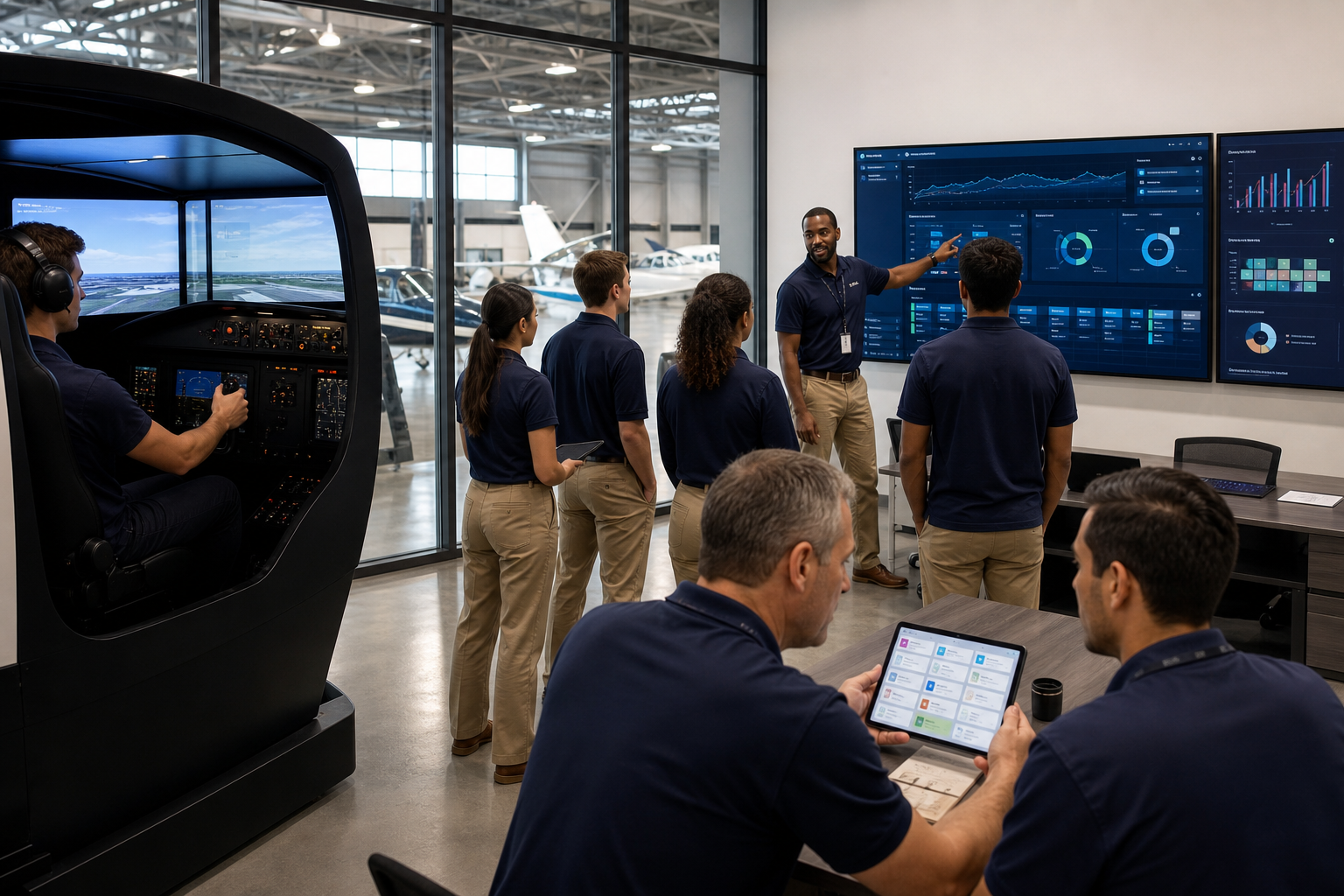
Behind every successful flight school is a demanding operation
Running a flight school means coordinating students, instructors, aircraft, maintenance schedules, and regulatory requirements—all at once. When your scheduling, training records, and maintenance data live in separate systems, small problems multiply into operational bottlenecks.
FlightLogger serves more than 215 flight training organizations across 50+ countries, and the pattern is consistent: schools running on disconnected workflows face the same set of recurring challenges. This article outlines the top 10 flight school management challenges caused by fragmented systems—and what it takes to address them.
Quick guide: Top 10 flight school management challenges
- Scheduling conflicts and resource bottlenecks: Aircraft and instructor availability clashing with student bookings
- Inconsistent student progress tracking: Training records scattered across multiple systems
- Audit readiness gaps: Documentation not organized for regulatory inspections
- Instructor workload imbalances: Uneven distribution of flight hours and responsibilities
- Maintenance coordination failures: Aircraft groundings due to poor scheduling sync
- Communication breakdowns: Missed updates between staff, students, and instructors
- No-show management difficulties: Lack of automated reminders increasing cancellation rates
- Multi-location coordination gaps: Inconsistent processes across campuses
- Delayed decision-making: Lack of real-time operational visibility
- Scaling limitations: Growth constrained by administrative overhead
Why these challenges matter for flight schools
Flight schools operate under constant pressure to meet regulatory standards, keep aircraft flying, and graduate students on schedule. When the systems supporting these operations don't connect, the result is wasted time, frustrated instructors, and students who fall behind.
The challenges outlined here aren't theoretical. They're based on conversations with flight school operators, documented implementation experiences, and feedback from training organizations that have moved from fragmented workflows to centralized platforms.
1. Scheduling conflicts and resource bottlenecks
Aircraft availability, instructor schedules, and student bookings rarely align on their own. Without a centralized view, double-bookings happen. Instructors show up to find aircraft in maintenance. Students arrive for lessons that never got confirmed.
FlightLogger gives you real-time visibility into aircraft readiness, instructor availability, and regional resource constraints. This means you can spot conflicts before they happen—not after a student is already on the ramp.
What causes scheduling conflicts?
Most scheduling problems trace back to information living in separate places. When maintenance schedules don't sync with booking calendars, aircraft get scheduled for training when they're due for inspection. When instructors manage their own availability in personal calendars, the front desk has no way to see the full picture.
How to address scheduling bottlenecks
- Centralized calendar: Aircraft, instructor, and student schedules visible in one place
- Maintenance integration: Automatic blocks on aircraft approaching inspection intervals
- Dynamic rescheduling: Weather cancellations trigger automatic rebooking suggestions
- Real-time updates: Changes sync across all devices immediately
2. Inconsistent student progress tracking
When training records live in different systems—or worse, on paper—tracking student progression becomes a manual exercise. Instructors grade differently. Progress checkpoints get missed. Students don't know where they stand.
This inconsistency creates problems for both the student and the school. Students lose motivation when they can't see clear progress. Schools lose the ability to identify students who need additional support before they fall too far behind.
The impact of fragmented progress tracking
A study on pilot training challenges identified lack of progress visibility as a major factor in student attrition. When students don't understand how they're progressing, they're more likely to become discouraged and drop out.
FlightLogger addresses this by centralizing all training records, grading, and competency assessments in one system. Students can see exactly where they are in their training program, and instructors can track progress across their entire student roster.
3. Audit readiness gaps
Regulatory inspections require documentation that's organized, complete, and accessible. When records are scattered across different systems, audit preparation becomes a scramble. Staff spend hours—sometimes days—gathering paperwork that should be available instantly.
What audit readiness looks like
Flight schools using FlightLogger report zero-finding authority audits due to automated documentation and centralized records. The platform handles documentation in accordance with regulations, supporting compliance across multiple regulatory environments simultaneously.
Instead of audit prep being a crisis, it becomes a routine part of operations. Records are always current, always accessible, and always formatted for inspector review.
4. Instructor workload imbalances
Some instructors end up overloaded while others have gaps in their schedules. Without visibility into total flight hours, ground instruction time, and administrative duties, workload distribution happens by accident rather than by design.
This imbalance affects instructor satisfaction and student experience. Overworked instructors burn out. Underutilized instructors question their role. Students assigned to overloaded instructors may experience rushed lessons or frequent rescheduling.
Balancing instructor workloads
FlightLogger gives operations managers visibility into instructor schedules and utilization rates. This allows for proactive workload distribution before imbalances become problems. The system tracks not just scheduled flights but also ground instruction, briefings, and administrative time.
5. Maintenance coordination failures
Aircraft maintenance and training operations often run on separate tracks. When these schedules don't communicate, aircraft get grounded unexpectedly—or worse, scheduled for training when they shouldn't be flying.
The aviation training management literature consistently identifies maintenance sync as a critical operational challenge. Aircraft availability directly impacts training capacity, and unplanned groundings ripple through the entire schedule.
How FlightLogger handles maintenance integration
FlightLogger Maintenance integrates directly with the training schedule. Aircraft approaching maintenance intervals are automatically flagged. Scheduled inspections block booking automatically. This prevents the scenario where a student arrives for a flight and the aircraft is in the hangar.
6. Communication breakdowns
When severe weather forces last-minute cancellations, or when instructor availability changes, the ability to communicate rapidly becomes critical. Ad-hoc messaging channels—text messages, email chains, phone calls—often lead to confusion, missed updates, and administrative overload.
Students show up for cancelled lessons. Instructors don't know about schedule changes. Front desk staff spend hours making phone calls that could be automated.
Centralized communication systems
FlightLogger's automated notification system eliminates the need for manual outreach during schedule changes. Weather cancellations trigger automatic alerts to affected students and instructors. Schedule updates sync to all stakeholders immediately. The result is fewer missed communications and reduced administrative burden.
7. No-show management difficulties
Student no-shows waste aircraft time, instructor hours, and training capacity. Without automated reminders, no-show rates climb—especially during holiday periods when students are distracted by other obligations.
Reducing no-shows through automation
FlightLogger sends automated reminders before scheduled lessons. During high-risk periods—holidays, exam weeks, weather-prone seasons—reminder frequency can be increased. Schools using the platform report documented reductions in no-show rates, protecting their most valuable resource: scheduled aircraft time.
8. Multi-location coordination gaps
Flight schools operating across multiple campuses face additional coordination challenges. Training standards may drift between locations. Students transferring between sites encounter inconsistent processes. Administrative staff duplicate effort because they can't see what's happening at other facilities.
Standardizing operations across locations
FlightLogger enables flight schools to standardize training programs and grading across locations while maintaining the flexibility for local variations where needed. Operations managers get visibility into all campuses from a single dashboard. Students can train at any location with their records following them automatically.
9. Delayed decision-making
When operational data requires manual gathering and reporting, decisions get delayed. By the time a report is compiled, the situation has changed. Managers make choices based on information that's already outdated.
Real-time operational visibility
FlightLogger gives operational leaders real-time visibility into aircraft utilization, student progress, instructor availability, and training throughput. This enables faster, more informed decisions. When you can see the current state of operations at any moment, you can respond to problems before they become crises.
10. Scaling limitations
Growth exposes the limits of manual processes. What worked with 50 students doesn't work with 200. Administrative overhead increases faster than enrollment. Staff spend more time on coordination and less time on actual training delivery.
Flight schools using FlightLogger have documented the ability to triple enrollment without adding administrative staff. The platform handles the increased coordination complexity that growth demands, freeing staff to focus on student success rather than administrative tasks.
Building for growth
The schools that scale successfully are those that address these operational challenges before growth exposes them. FlightLogger gives you the operational foundation to grow without sacrificing quality or compliance.
How to identify which challenges affect your operation
Not every flight school faces all ten challenges equally. Some may have solved scheduling but face audit readiness gaps. Others may have strong compliance but limited ability to scale.
Start by mapping where your staff spends the most time on coordination and administrative tasks. These time drains typically point to the underlying operational challenges. Then prioritize addressing the challenges that most directly affect your ability to train students effectively and grow sustainably.
Why FlightLogger addresses these challenges differently
FlightLogger was built by aviation professionals, for aviation professionals. The platform reflects the real operational needs of flight training organizations—not generic software adapted for aviation use.
This matters because flight training has requirements that generic scheduling or management software doesn't address. Regulatory compliance, maintenance integration, competency-based training (CBTA), and multi-jurisdiction operations all require purpose-built solutions.
FlightLogger serves more than 215 organizations across 50+ countries because the platform addresses these aviation-specific challenges directly. Schools using the system report 30% reductions in administrative overhead, double-digit improvements in on-time lesson starts, and zero-finding authority audits.
Want to see how FlightLogger addresses the specific challenges your operation faces? Book a walkthrough and see the platform in action.
FAQs about flight school management challenges
What is the biggest challenge facing flight schools today?
Scheduling coordination ranks as the most common operational challenge. When aircraft, instructor, and student schedules don't sync automatically, conflicts multiply. FlightLogger addresses this by centralizing all scheduling into one system with real-time visibility.
How do disconnected systems affect student progress?
Fragmented training records make it difficult to track student progression consistently. Instructors may grade differently, checkpoints get missed, and students lose visibility into their own progress. FlightLogger centralizes all training records and competency assessments in one platform.
Why is audit preparation so time-consuming?
Without centralized documentation, audit prep requires gathering records from multiple systems. This manual process takes days instead of minutes. FlightLogger maintains audit-ready documentation at all times, with records organized for regulatory inspections automatically.
How can flight schools reduce student no-shows?
Automated reminders significantly reduce no-show rates. FlightLogger sends reminders before scheduled lessons and can increase reminder frequency during high-risk periods like holidays. Schools report measurable reductions in missed appointments.
What makes scaling a flight school difficult?
Administrative overhead increases faster than enrollment when processes rely on manual coordination. FlightLogger enables schools to grow without proportionally increasing administrative staff. Flight schools have documented the ability to triple enrollment without adding staff.