.png?width=201&height=201&name=Maintenance%20(Videoannonce%20%E2%80%93%20LinkedIn).png)

Top 8 Flight Curriculum Planning Fixes for Schools
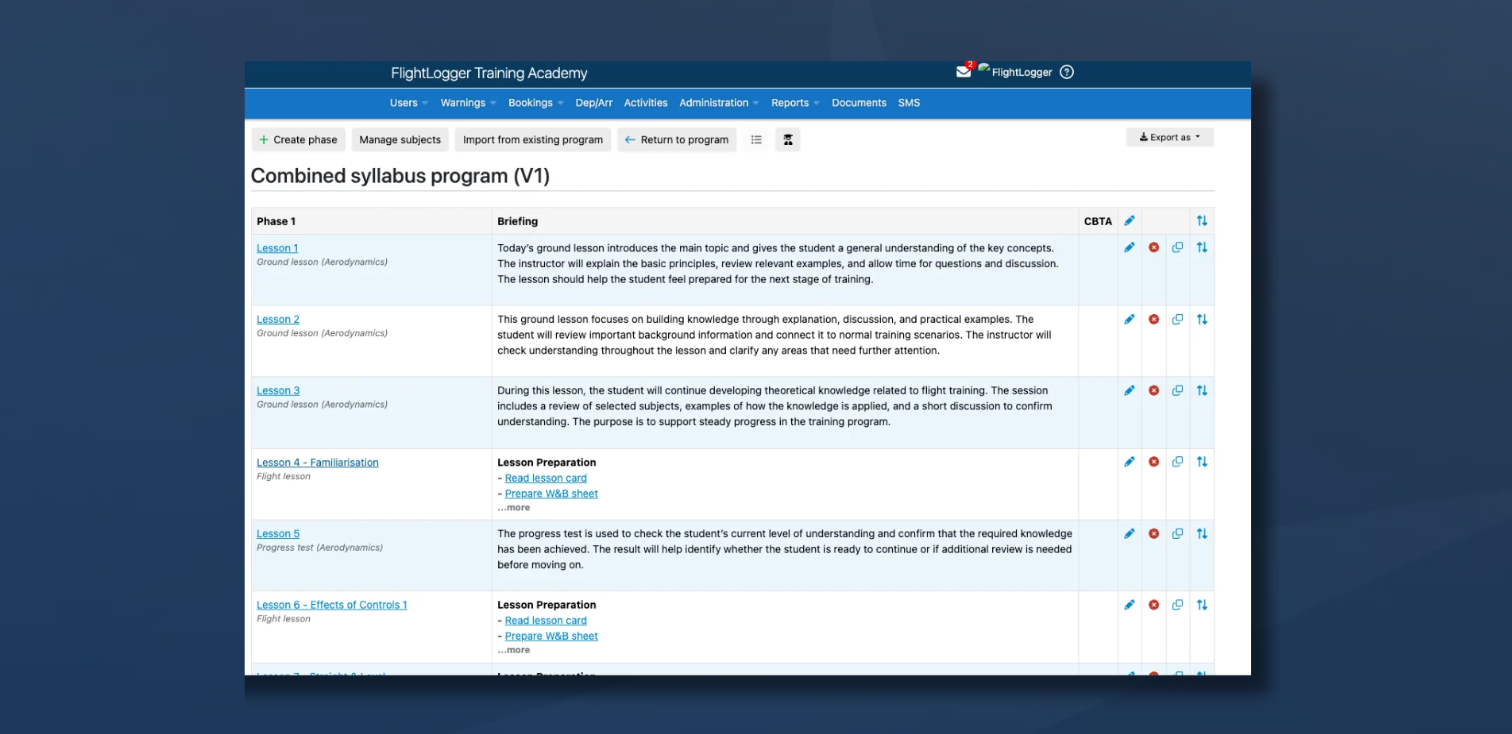
 Amalie Rasmussen
·
3 minute read
Amalie Rasmussen
·
3 minute read

Discover eight practical ways to improve flight curriculum planning, reduce scheduling delays, and create a more efficient flight training operation.
Quick Answer
The best way to improve flight school management is to connect curriculum planning with scheduling, instructor availability, aircraft resources, and student progress. Modern flight schools use integrated systems to eliminate manual bottlenecks, improve resource utilization, and keep students progressing through training without unnecessary delays.
Why Curriculum Planning Impacts Flight School Efficiency
Curriculum planning influences far more than lesson content.
It determines:
- How students progress
- How instructors deliver training
- How aircraft are utilized
- How schedules are built
- How efficiently the school operates
When curriculum planning is disconnected from daily operations, even small issues can lead to scheduling conflicts, administrative overhead, and slower student progression.
The good news is that many of these problems can be solved through better planning and connected operational workflows.
1. Connect Curriculum Planning with Scheduling
One of the biggest mistakes flight schools make is planning the curriculum separately from scheduling.
Lessons may be sequenced correctly academically but become difficult to deliver because instructors, aircraft, or simulators aren't available.
The fix
Build training programs that work alongside operational scheduling, ensuring lesson progression aligns with available resources.
Benefit: Fewer scheduling conflicts and smoother student progression.
2. Combine Flight and Ground Training
Managing flight and ground training independently often creates unnecessary delays.
Students may complete one portion of their training while waiting for the other to catch up.
The fix
Plan flight and ground training as one connected learning journey.
Benefit: Better continuity and fewer administrative handovers.
3. Standardize Lesson Objectives
If every instructor interprets lessons differently, training becomes inconsistent.
Students may repeat topics unnecessarily or progress at different rates.
The fix
Use standardized lesson objectives and assessment criteria throughout the curriculum.
Benefit: More consistent instruction and easier instructor collaboration.
4. Use Student Progress to Drive Planning
Curriculum planning shouldn't end once the syllabus is created.
Schools should continuously monitor:
- Lesson completion
- Competency development
- Delayed milestones
- Training bottlenecks
The fix
Review student progress regularly and adjust planning where necessary.
Benefit: Earlier intervention and more efficient pilot training.
5. Plan Around Available Resources
Every lesson requires multiple resources working together.
Curriculum planning should account for:
- Aircraft availability
- Instructor capacity
- Simulator access
- Classroom scheduling
The fix
Coordinate curriculum planning with resource planning.
Benefit: Improved aircraft utilization and fewer cancelled lessons.
6. Replace Manual Curriculum Tracking
Paper records and spreadsheets make it difficult to understand where students are within the program.
Administrators often spend hours updating records manually.
The fix
Digitize curriculum management with real-time training records.
Benefit: Less administration and better visibility across the school.
7. Build Compliance Into the Curriculum
Compliance shouldn't rely on additional paperwork after lessons are complete.
Instead, lesson documentation, assessments, and instructor records should naturally support regulatory requirements.
The fix
Embed compliance documentation directly into training workflows.
Benefit: Simpler audit preparation and stronger operational consistency.
8. Review Curriculum Performance Regularly
A curriculum should continue evolving.
Operational data often reveals opportunities to improve:
- Student completion times
- Lesson sequencing
- Resource allocation
- Instructor workload
- Scheduling efficiency
The fix
Review operational performance and curriculum effectiveness throughout the year.
Benefit: Continuous improvement rather than reactive changes.
What These Improvements Achieve
When curriculum planning supports operations, flight schools often experience:
- Faster student progression
- Better aircraft utilization
- Improved instructor coordination
- Reduced scheduling conflicts
- Lower administrative workload
- Greater operational visibility
- More consistent training delivery
- Improved compliance readiness
Rather than creating more work, the curriculum becomes a tool for improving operational efficiency.
Traditional Curriculum Planning vs Connected Flight School Management
| Traditional Planning | Connected Flight School Management |
|---|---|
| Static syllabus documents | Dynamic digital training programs |
| Manual progress tracking | Real-time student progress |
| Separate scheduling | Integrated scheduling and curriculum |
| Paper lesson records | Digital training records |
| Disconnected systems | Connected operational workflows |
| Reactive planning | Continuous optimization |
Compare Flight School Management Platforms
Several platforms help flight schools improve curriculum planning and operational efficiency.
| Platform | Best For | Key Strengths |
|---|---|---|
| FlightLogger | Flight schools seeking a complete Flight School Operating System | Combined syllabus management, student progress, scheduling, compliance, maintenance visibility, operational reporting |
| Flight Schedule Pro | Scheduling-focused organizations | Scheduling and training administration |
| Aviatize | Growing flight schools | Student management and operational workflows |
| Flight Circle | Smaller academies | Scheduling and student administration |
| Talon Systems | Larger training organizations | Training administration and compliance |
| Tailplane | Scheduling-focused operations | Resource planning and scheduling |
Each platform offers different capabilities. Schools should evaluate whether they simply need curriculum administration or a platform that connects curriculum planning with scheduling, student progression, compliance, and operational oversight.
Frequently Asked Questions
How can flight schools improve efficiency?
Flight schools improve efficiency by connecting curriculum planning with scheduling, instructor coordination, aircraft management, student progress tracking, and compliance workflows. Integrated operational systems reduce manual work and improve resource utilization.
What is flight curriculum planning?
Flight curriculum planning is the process of organizing flight and ground training into a structured learning path that supports student progression while considering operational resources and regulatory requirements.
Why does curriculum planning affect scheduling?
Lesson sequencing directly influences when students need instructors, aircraft, classrooms, and simulators. Poor curriculum planning often creates unnecessary scheduling conflicts and resource bottlenecks.
How do modern flight schools manage curriculum planning?
Many flight schools now use integrated flight school management software to connect curriculum planning with scheduling, digital training records, instructor management, compliance, and operational reporting.
Build a Curriculum That Supports Better Operations
The most efficient flight schools understand that curriculum planning is about more than education—it's about operations.
When curriculum planning, scheduling, student progress, compliance, and instructor coordination work together, schools reduce delays, improve resource utilization, and create a better training experience for everyone involved.
As the Flight School Operating System, FlightLogger helps flight schools connect every stage of the training journey—from curriculum planning and scheduling to digital training records, compliance, maintenance, and operational reporting.