.png?width=201&height=201&name=Maintenance%20(Videoannonce%20%E2%80%93%20LinkedIn).png)

12 Causes of Flight School Management Complexity (And How Modern Software Solves Them)
 Amalie Rasmussen
·
5 minute read
Amalie Rasmussen
·
5 minute read

Running a successful flight school isn't just about delivering excellent flight instruction. It's about coordinating students, instructors, aircraft, maintenance, compliance, scheduling, and administration—all while ensuring training continues safely and efficiently.
As flight schools grow, that complexity increases exponentially. What worked with 20 students often breaks down with 100. Manual processes become bottlenecks, communication gaps grow, and staff spend more time managing operations than supporting students.
The good news? Most operational complexity isn't caused by the number of students—it's caused by disconnected systems and manual workflows.
This guide explores the 12 biggest causes of flight school management complexity and explains how modern flight school management software helps schools simplify operations without sacrificing flexibility or compliance.
Quick Answer
The biggest causes of flight school management complexity are disconnected systems, manual scheduling, paper-based records, aircraft coordination, instructor availability, compliance requirements, and poor operational visibility. Modern flight school management software connects these workflows into one platform, reducing administrative work, improving coordination, and helping flight schools scale more efficiently.
Why Flight School Management Is More Complex Than Ever
Unlike many training organizations, flight schools must coordinate people, aircraft, instructors, regulations, weather, maintenance, and training programs—all in real time.
Every lesson depends on multiple resources being available simultaneously.
If just one piece changes, the entire schedule can be affected.
That's why growing schools increasingly rely on connected software rather than isolated tools.
1. Every Lesson Depends on Multiple Resources
Unlike classroom education, a flight lesson requires:
- A student
- An instructor
- An available aircraft
- Suitable weather
- A completed maintenance schedule
- The correct training stage
Managing these dependencies manually becomes increasingly difficult as operations grow.
Modern flight scheduling software coordinates all resources in one schedule, reducing conflicts and improving operational planning.
2. Student Progression Isn't Linear
Every student learns at a different pace.
Some require additional lessons.
Others progress faster.
Managing individual training journeys with spreadsheets often leads to inconsistent records and missed milestones.
How software helps
Integrated training management connects syllabi, competencies, assessments, and lesson history to provide a real-time view of every student's progression.
3. Instructor Availability Changes Constantly
Instructor schedules change because of:
- Flight hours
- Leave
- Weather
- Check rides
- Additional responsibilities
Without centralized scheduling, coordinators spend hours updating calendars.
How software helps
Instructor availability updates automatically across scheduling and operational planning.
4. Aircraft Are Constantly Moving
Aircraft rarely stay available for long.
They're continuously moving between:
- Training flights
- Maintenance
- Inspections
- Ferry flights
- Cleaning
- Unexpected repairs
Managing this information manually often creates scheduling conflicts.
How software helps
Aircraft status is shared across scheduling, maintenance, and operational planning from one platform.
5. Compliance Never Stops
Compliance isn't something schools prepare for once a year.
It's part of every training activity.
Schools must maintain:
- Student records
- Instructor qualifications
- Medical certificates
- Flight documentation
- Training records
- Regulatory reports
Paper documentation makes this increasingly difficult.
How software helps
Digital records ensure documentation remains organized and audit-ready throughout the year.
6. Information Lives in Too Many Places
Many flight schools use:
- Excel
- Google Sheets
- Whiteboards
- Accounting software
- Paper records
- Maintenance software
Each system contains different information.
No one has the complete picture.
How software helps
Modern aviation training administration platforms centralize operational data so everyone works from the same information.
7. Manual Administration Doesn't Scale
As schools grow, administration often grows faster than student numbers.
Staff spend time:
- Updating spreadsheets
- Entering duplicate information
- Answering scheduling questions
- Producing reports
- Searching for documents
These repetitive tasks reduce overall flight school efficiency.
How software helps
Automation reduces manual work by connecting operational workflows instead of requiring duplicate data entry.
8. Communication Breaks Down
Disconnected systems often result in:
- Last-minute schedule changes
- Missed notifications
- Conflicting information
- Outdated records
- Unclear responsibilities
Poor communication affects instructors, students, and administrators alike.
How software helps
One shared platform provides real-time information for everyone involved in training.
9. Maintenance and Scheduling Operate Separately
One of the most common operational problems is maintenance working independently from scheduling.
An aircraft may appear available even though maintenance is planned.
This creates unnecessary disruptions.
How software helps
Integrated maintenance planning ensures aircraft availability is reflected automatically in scheduling.
10. Managers Lack Operational Visibility
Many schools struggle to answer simple questions:
- Which students are falling behind?
- Which instructors are fully booked?
- Which aircraft are underutilized?
- Where are scheduling bottlenecks?
Without centralized reporting, leaders often rely on assumptions instead of data.
How software helps
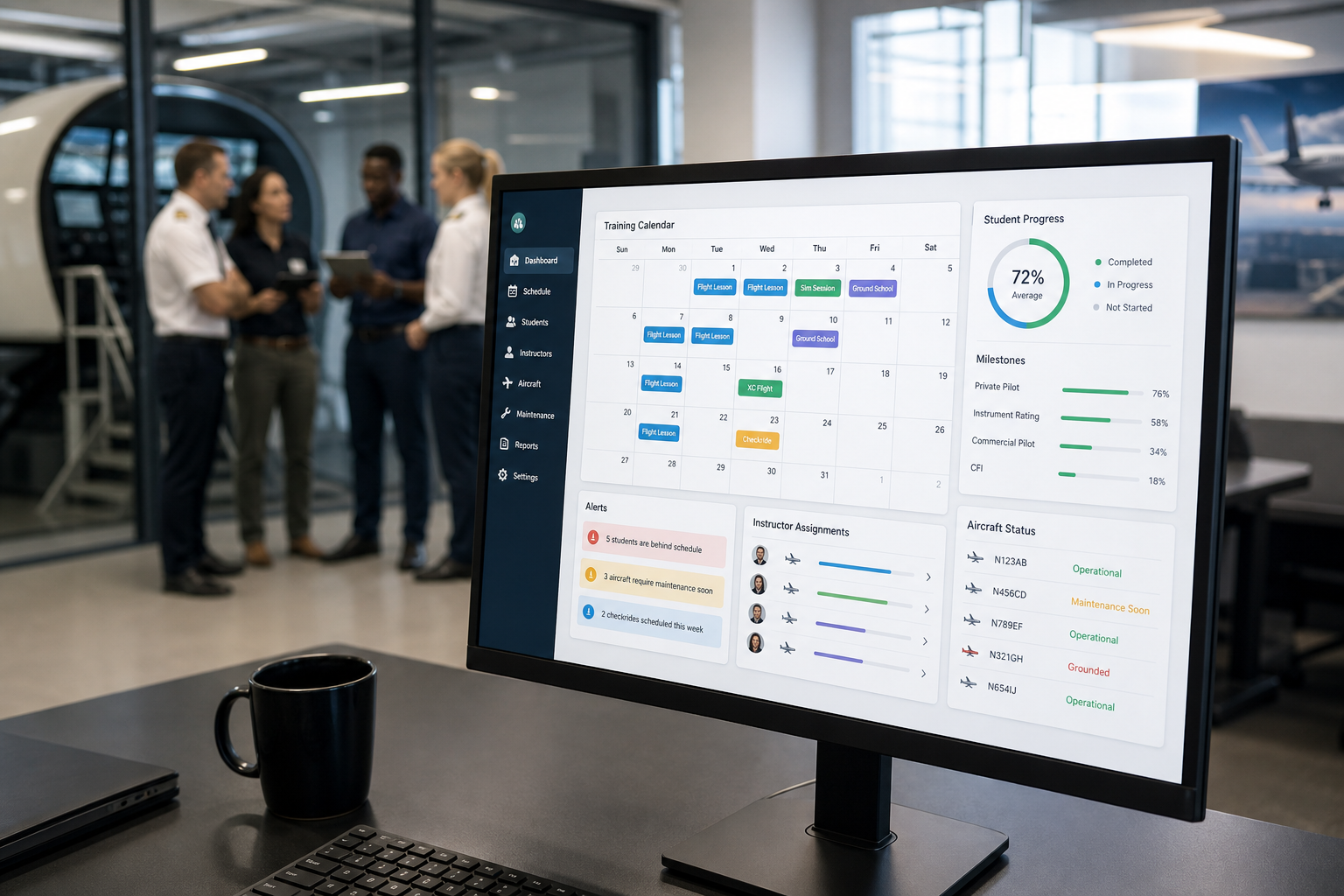
Real-time dashboards provide visibility into every part of the operation.
11. Growth Creates Exponential Complexity
Adding:
- More students
- More instructors
- More aircraft
- More locations
- More training programs
doesn't increase complexity by 10%—it often doubles it.
Manual processes rarely scale successfully.
How software helps
Connected workflows allow schools to grow without increasing administrative overhead at the same pace.
12. Disconnected Systems Create Duplicate Work
Perhaps the biggest challenge is duplicate administration.
The same information is often entered into:
- Scheduling software
- Student records
- Billing systems
- Compliance documentation
- Reporting tools
This wastes time and increases the risk of errors.
How software helps
A connected platform updates information once and shares it across the entire operation.
The Common Thread Behind Every Challenge
Looking at these challenges, one pattern becomes clear.
The biggest problem isn't scheduling.
It isn't compliance.
It isn't maintenance.
It's that each department often works independently.
When systems don't communicate, people become responsible for moving information between them.
That's where delays, mistakes, and inefficiencies begin.
How Integrated Flight School Management Software Reduces Complexity
Modern flight school management software connects the entire operation.
Instead of separate tools, one platform brings together:
- Student management
- Flight scheduling
- Instructor coordination
- Aircraft operations
- Digital training records
- Maintenance planning
- Compliance management
- Financial administration
- Operational reporting
When these workflows are connected, information only needs to be entered once—and everyone works from the same real-time data.
Signs Your Flight School Has Outgrown Manual Processes
You may have reached the point where integrated software is needed if your team regularly experiences:
- Scheduling conflicts between instructors and aircraft
- Duplicate data entry
- Paper-based training records
- Difficulty preparing for audits
- Limited visibility into operations
- Time-consuming administrative work
- Communication gaps between departments
- Challenges scaling your organization
These are often signs that disconnected processes—not your people—are slowing the operation down.
How FlightLogger Simplifies Flight School Operations
FlightLogger – The Flight School Operating System is built to reduce operational complexity by connecting every part of a flight school's workflow.
FlightLogger brings together:
- Student training and progression
- Flight and ground scheduling
- Instructor management
- Aircraft operations
- Digital training records
- Maintenance planning
- Compliance documentation
- Financial administration
- Business insights and reporting
Rather than relying on multiple disconnected tools, schools can manage their entire operation from one platform—improving coordination, reducing manual work, and giving every department access to the same real-time information.
Frequently Asked Questions
Why is flight training management so complex?
Flight training involves coordinating students, instructors, aircraft, maintenance, compliance, weather, and scheduling simultaneously. As schools grow, managing these interconnected workflows manually becomes increasingly difficult.
What are the biggest challenges in running a flight school?
The biggest challenges include scheduling conflicts, manual administration, paper-based records, compliance management, aircraft coordination, instructor availability, and limited operational visibility.
How can flight school management software improve efficiency?
Modern flight school management software connects scheduling, training, compliance, maintenance, reporting, and administration into one platform. This reduces duplicate work, improves communication, and streamlines daily operations.
What causes inefficiencies in pilot training operations?
Common causes include disconnected systems, manual scheduling, duplicate data entry, poor communication, limited visibility, and paper-based workflows. Integrated software helps eliminate these inefficiencies by connecting operational processes.
The Future of Flight School Management
As aviation training organizations grow, operational complexity is inevitable—but unnecessary complexity isn't.
The most successful flight schools aren't those with the most software. They're the ones with the most connected operations.
By replacing manual processes and disconnected tools with flight school management software, schools can reduce administrative overhead, improve pilot training operations, simplify aviation training administration, and create a more efficient experience for instructors, students, and administrators alike.
That's why more organizations are choosing FlightLogger – The Flight School Operating System to bring every aspect of flight school operations together in one connected platform.
Book a Walkthrough!
See FlightLogger in action and discover how we can help you achieve significant efficiency gains, streamline compliance, and make your daily operations smoother.