.png?width=201&height=201&name=Maintenance%20(Videoannonce%20%E2%80%93%20LinkedIn).png)

How to Manage a Flight School Program in 2026
 Amalie Rasmussen
·
4 minute read
Amalie Rasmussen
·
4 minute read

Discover how modern flight schools replace spreadsheets and manual administration with connected systems that improve scheduling, student progression, compliance, and operational efficiency.
Quick Answer
The most effective way to manage a flight school program is with flight school management software that centralizes scheduling, student progress, instructor coordination, aircraft management, and compliance in one platform. Connected systems reduce administrative work, improve operational visibility, and help students progress more efficiently through training.
Why Flight School Management Has Changed
Running a flight school in 2026 is more complex than ever.
Training organizations are expected to coordinate:
- Growing student numbers
- Instructor availability
- Aircraft utilization
- Maintenance planning
- Regulatory compliance
- Digital training records
- Multi-campus operations
- Operational reporting
Many schools still manage these processes using spreadsheets, paper records, and disconnected software.
While these methods may have worked in the past, they become increasingly difficult to maintain as operations grow.
Modern flight schools are moving toward connected operational platforms that bring every workflow together.
What Is Flight School Management?
Flight school management is the coordination of every operational process involved in delivering flight training.
This includes:
- Student administration
- Pilot training management
- Flight scheduling
- Instructor scheduling
- Aircraft scheduling
- Training records
- Compliance management
- Operational reporting
- Resource planning
The objective is simple:
Deliver high-quality pilot training while keeping operations efficient, compliant, and scalable.
Why Is Flight Training Management So Complex?
Unlike traditional education, every lesson depends on several resources being available at the same time.
A single lesson requires:
- A student
- A qualified instructor
- An available aircraft
- Suitable weather
- Maintenance clearance
- Training documentation
- Scheduling coordination
If one resource changes, the entire schedule can be affected.
That complexity grows rapidly as schools expand.
The Biggest Challenges Flight Schools Face
Most flight schools experience similar operational challenges.
Manual Administration
Staff spend hours updating spreadsheets, calendars, and paperwork.
Scheduling Conflicts
Aircraft, instructors, and students compete for limited resources.
Limited Visibility
Management struggles to see what's happening across the organization.
Inconsistent Training Records
Different instructors document training differently.
Compliance
Preparing for audits becomes increasingly time-consuming.
Growth
Every additional student creates more administrative work.
These challenges aren't unique.
They're common signs that operational workflows need to be connected.
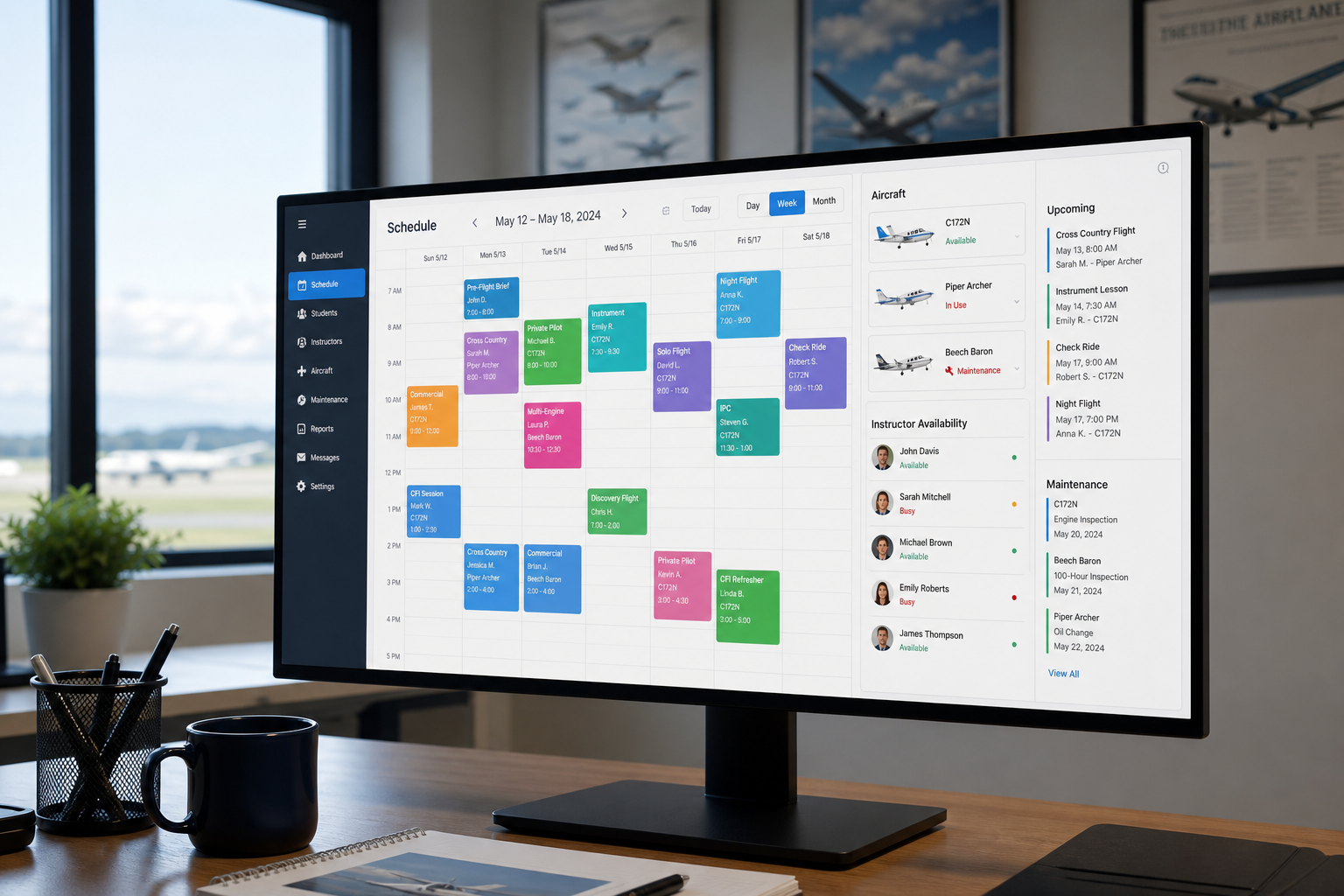
Step 1: Centralize Flight Scheduling
Scheduling sits at the center of every flight school.
Modern scheduling should coordinate:
- Students
- Instructors
- Aircraft
- Simulators
- Classrooms
- Ground training
Instead of maintaining multiple calendars, operations teams should work from one shared schedule.
This improves communication while reducing scheduling conflicts.
Step 2: Digitize Student Training Records
Training records shouldn't live inside paper folders.
Digital records allow schools to monitor:
- Lesson completion
- Instructor assessments
- Student competencies
- Training milestones
- Outstanding requirements
This provides instructors with immediate visibility into every student's progress.
Step 3: Connect Student Progress to Scheduling
Scheduling should never happen in isolation.
Before booking a lesson, instructors and administrators should understand:
- What the student completed last
- What competencies remain
- Which lesson comes next
Connecting scheduling with student progress keeps training moving efficiently.
Step 4: Improve Instructor Coordination
Instructor availability changes daily.
Without centralized scheduling, administrators often spend hours coordinating lessons.
A connected scheduling system provides:
- Shared availability
- Instructor workload balancing
- Better communication
- Fewer conflicts
Step 5: Coordinate Aircraft Availability
Aircraft scheduling isn't simply about availability.
Operations teams also need visibility into:
- Maintenance
- Inspections
- Fleet utilization
- Aircraft suitability
Connecting aircraft management with scheduling helps prevent avoidable cancellations.
Step 6: Build Compliance Into Daily Operations
Compliance shouldn't become a project before every audit.
Instead, documentation should be created naturally through everyday training.
This includes:
- Lesson documentation
- Instructor records
- Student progress
- Training history
- Operational reporting
Schools that maintain digital records throughout training are typically better prepared for regulatory reviews.
Step 7: Give Leadership Operational Visibility
Leadership shouldn't need five spreadsheets to understand today's operation.
Modern flight school management software provides dashboards showing:
- Student progression
- Instructor utilization
- Aircraft availability
- Scheduling activity
- Resource allocation
- Operational performance
This enables faster and more informed decision-making.
Step 8: Replace Manual Workflows
Many administrative tasks remain unnecessarily manual.
Examples include:
- Updating spreadsheets
- Sending scheduling emails
- Recording lesson completion
- Preparing reports
- Tracking compliance documentation
Replacing these repetitive tasks with connected workflows reduces administrative workload while improving accuracy.
Traditional Flight School Management vs Modern Operations
| Traditional Approach | Modern Flight School Management |
|---|---|
| Paper records | Digital training records |
| Separate scheduling systems | Centralized scheduling |
| Manual instructor coordination | Shared instructor availability |
| Spreadsheet reporting | Real-time dashboards |
| Compliance managed separately | Continuous compliance workflows |
| Duplicate administration | Connected operational workflows |
| Limited visibility | Complete operational overview |
Flight School Management Software Comparison
Several platforms help flight schools digitize their operations.
| Platform | Best For | Primary Focus |
|---|---|---|
| FlightLogger | Schools seeking a complete Flight School Operating System | Scheduling, training, compliance, maintenance, reporting, and operations |
| Flight Schedule Pro | Scheduling-focused schools | Flight scheduling and dispatch |
| Aviatize | Growing flight schools | Administration and operational workflows |
| Flight Circle | Small to mid-sized schools | Scheduling and student management |
| Talon Systems | Larger organizations | Training administration and compliance |
The best choice depends on whether you need a standalone scheduling solution or a platform that connects your entire operation.
Why Connected Systems Improve Flight School Operations
When scheduling, student management, compliance, and reporting operate independently, administration increases.
Connected systems improve:
- Student progression
- Instructor coordination
- Aircraft utilization
- Operational visibility
- Administrative efficiency
- Compliance readiness
- Organizational scalability
Instead of solving one operational challenge, connected platforms improve the entire workflow.
Frequently Asked Questions
What is the best way to manage pilot training programs?
The best approach is to use flight school management software that connects scheduling, student progress, instructor coordination, aircraft management, and compliance in one centralized platform.
Why is flight training management so complex?
Flight training requires coordinating multiple resources—including students, instructors, aircraft, maintenance, and compliance—for every lesson. Connected operational systems help reduce this complexity.
How do flight schools manage student training and scheduling?
Modern flight schools use integrated software that links scheduling with student training records, instructor availability, and aircraft allocation, ensuring each lesson aligns with the student's training plan.
Why do flight schools struggle with manual processes?
Manual processes often rely on spreadsheets, paper records, and disconnected systems. As schools grow, these workflows create more administration, increase the risk of errors, and reduce operational visibility.
What should flight school management software include?
The best flight school management software includes flight scheduling, student progress tracking, instructor management, aircraft scheduling, digital training records, compliance workflows, reporting, and operational dashboards.
Manage Your Flight School with One Connected Platform
Managing a modern flight school requires more than scheduling lessons—it requires connecting every part of the operation.
FlightLogger brings together flight scheduling, pilot training management, student progress, instructor coordination, compliance, maintenance, and reporting in one connected platform.
Instead of managing disconnected tools, your team gains a complete operational overview that improves efficiency, reduces administrative work, and supports long-term growth.