.png?width=201&height=201&name=Maintenance%20(Videoannonce%20%E2%80%93%20LinkedIn).png)

New FlightLogger Release: Automating Compliance and Scheduling for Scalable Flight Training
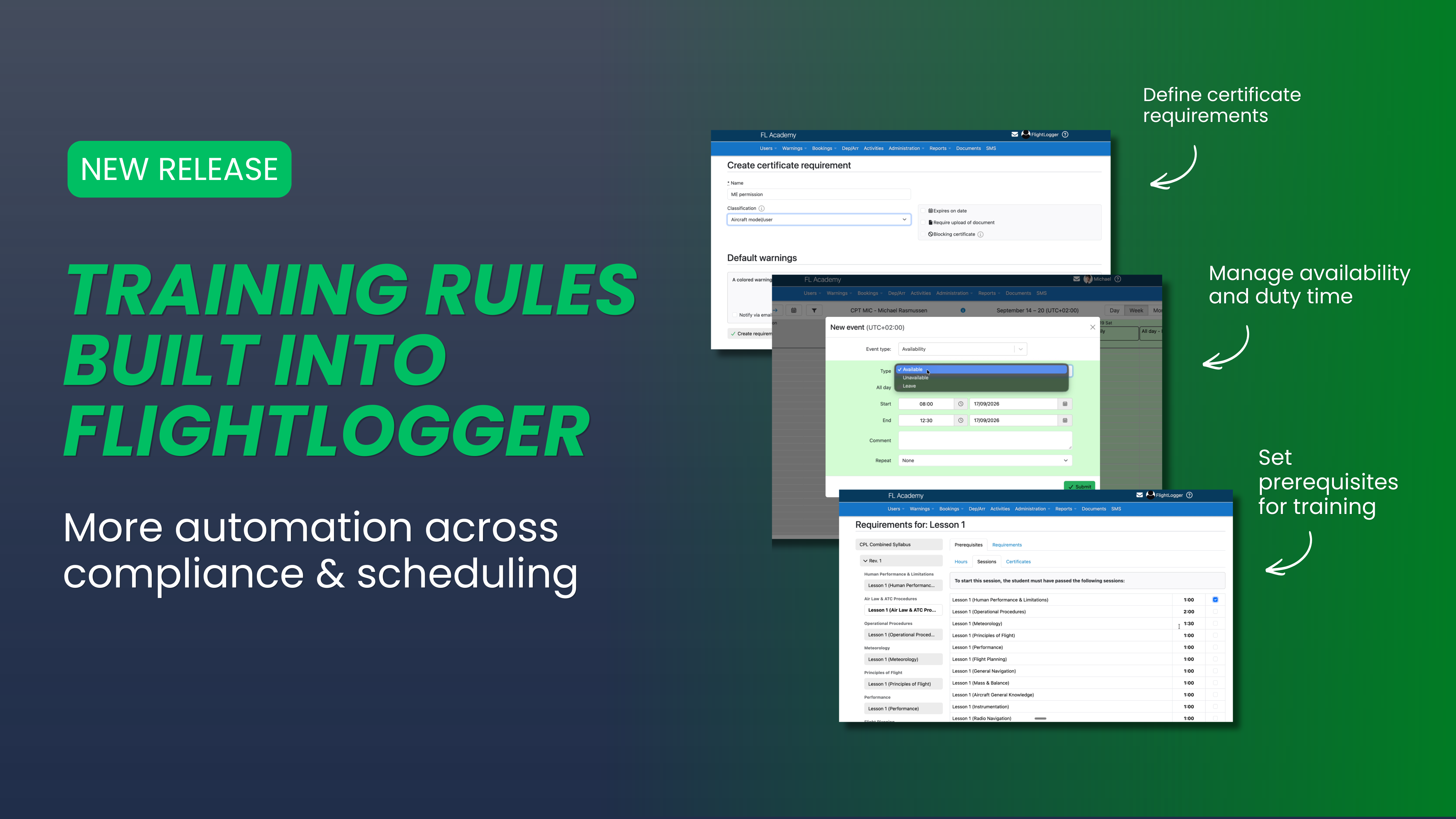
FlightLogger’s latest release brings more of your training rules directly into the platform - from prerequisites and instructor eligibility to duty-time visibility and student training records. The result is fewer manual checks, clearer scheduling decisions, and more consistent compliance as your operation grows.
Training rules should live in the system
As flight training organizations grow, so does the complexity behind every training activity.
Before a lesson can take place, the right student needs to be ready, the right instructor needs to be eligible, the required certificates need to be valid, and the activity needs to fit into an increasingly complex schedule.
When those checks depend on spreadsheets, manual processes, or knowledge held by a few experienced people, scaling becomes harder.
That is one of the challenges we are addressing with FlightLogger’s latest release.
The update introduces new capabilities across compliance, scheduling, training progression, reporting, and self-service, bringing more operational rules directly into the everyday FlightLogger workflow.
The principle behind the release is simple:
Your training rules should live in the system - not in people’s heads.
What’s new in FlightLogger?
Automated training prerequisites and certificate requirements
Flight schools can define requirements that students need to meet before progressing through training.
Certificate requirements can also be incorporated into the workflow, making it easier to see whether the necessary qualifications and documentation are in place.
Instead of relying on manual checks before every activity, these requirements become part of the training process inside FlightLogger.
For growing organizations with more students, instructors, programs, and locations, that creates a more consistent way of managing progression.
Aircraft model certificate requirements
Instructor and crew eligibility can now be more closely connected to the aircraft being scheduled.
Flight schools can define certificate requirements related to aircraft models, helping schedulers identify whether the relevant requirements have been met when assigning people to an activity.
This brings another important operational check closer to the scheduling workflow and reduces reliance on knowledge held outside the system.
Multiple ground instructors per lesson
Training does not always fit neatly into a one-instructor, one-lesson structure.
FlightLogger now supports assigning multiple ground instructors to a lesson, better reflecting how many flight schools actually conduct classroom and ground training.
This helps organizations maintain clearer records when several instructors contribute to the same training activity.
More control over Business Insights access
Operational data is most valuable when the right people can access it.
With the latest release, access to Business Insights can be managed more granularly, allowing organizations to provide relevant users with access to specific insights without necessarily giving them broader administrative permissions.
This supports a more data-driven operation while maintaining control over system access.
Self-service Pilot Training Records
Students can now generate and download their own Pilot Training Records as PDFs.
It is a relatively simple change with the potential to remove another recurring administrative handoff.
Instead of asking administration to generate the document, students can access it themselves when needed — giving them greater self-service while reducing routine work for staff.
Better duty-time visibility
The release also introduces additional controls and calendar visibility around duty time.
Administrators have more tools for managing duty timers, while calendar layers provide a clearer view of planned duty, actual duty, and leave.
Bringing this information together makes it easier to understand instructor availability and the operational picture behind the training schedule.
How can flight schools automate training compliance?
For many flight schools, compliance is not one individual process. It is the result of hundreds of small checks happening throughout the operation.
Has the student completed the required training?
Does the instructor have the necessary certificate?
Is the right person being assigned to the right aircraft?
Is the training progression correct?
Are the necessary records available?
As the number of students, instructors, aircraft, courses, and locations increases, manually managing those checks becomes increasingly difficult.
By moving more requirements into FlightLogger, flight schools can make those rules part of the workflow itself.
The objective is not simply to digitize another checklist. It is to create an operation where the system helps people make consistent decisions as complexity increases.
What does this mean for flight school operations?
For administrators, it means fewer repetitive checks and administrative handoffs.
For schedulers, it means having more of the information needed to make scheduling decisions available in the same environment.
For instructors and training managers, it means greater consistency around training progression and requirements.
And for leadership, it means building operational processes that are less dependent on individual knowledge as the organization grows.
Ultimately, this is about making FlightLogger capable of carrying more of the operational complexity behind modern flight training.
Building the Flight School Operating System
This release is another step in FlightLogger’s evolution into the Flight School Operating System.
Running a modern flight school involves much more than scheduling aircraft or recording completed lessons. Training progression, people, aircraft, compliance, records, operational planning, reporting, and data are interconnected.
The more those areas operate independently, the more manual coordination is required.
FlightLogger is being built around the opposite approach: connecting the workflows and information needed to run a flight training organization in one operational environment.
By bringing more training requirements and scheduling controls into the platform, this release strengthens the connection between training, compliance, scheduling, and operational oversight.
“As flight schools grow, more operational knowledge needs to live in the system — not in spreadsheets, manual checks or people’s heads. This release moves us further in that direction by making training requirements, eligibility and compliance part of the everyday workflow.”
— Kasper Valgren, CEO, FlightLogger
Built for flight schools that are growing
Growth introduces complexity.
More students create more training activity. More instructors create more scheduling combinations. More aircraft and locations introduce additional operational dependencies. And larger teams make it increasingly difficult to rely on informal knowledge and manual communication.
Technology should help absorb that complexity rather than add to it.
That is why we continue to focus on connecting more of the flight school operation and turning recurring manual processes into structured workflows.
The goal is straightforward: help flight schools grow without losing operational visibility, consistency, or control.
What’s next?
FlightLogger will continue developing automation, connectivity, and operational intelligence across the platform.
Each release moves us closer to an operating system where the different parts of a flight training organization work together - giving teams a clearer picture of what is happening today and a stronger foundation for what comes next.
Because scalable flight training requires more than software that records what happened.
It requires a system that helps the operation run.
About FlightLogger
FlightLogger is the Flight School Operating System, built to connect the workflows, people, training, and data behind modern flight training organizations.
Trusted by 220+ flight schools across 50+ countries, FlightLogger helps training organizations improve operational visibility, reduce administrative work, manage training progression, and keep their operation connected as they scale.
See the new capabilities in action
Want to see how FlightLogger can help bring more of your training rules, scheduling workflows, and operational processes into one connected system?
Request a demo and discover the Flight School Operating System.