.png?width=201&height=201&name=Maintenance%20(Videoannonce%20%E2%80%93%20LinkedIn).png)

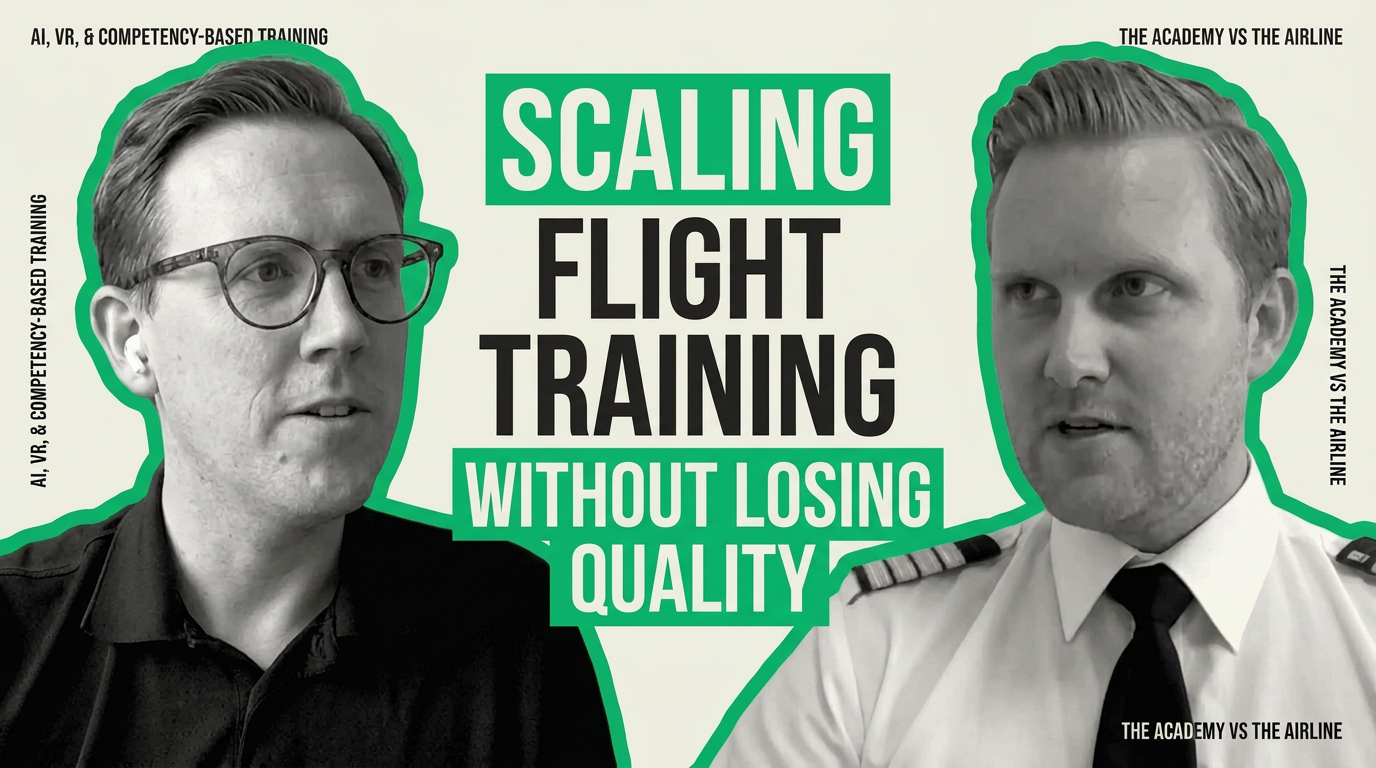
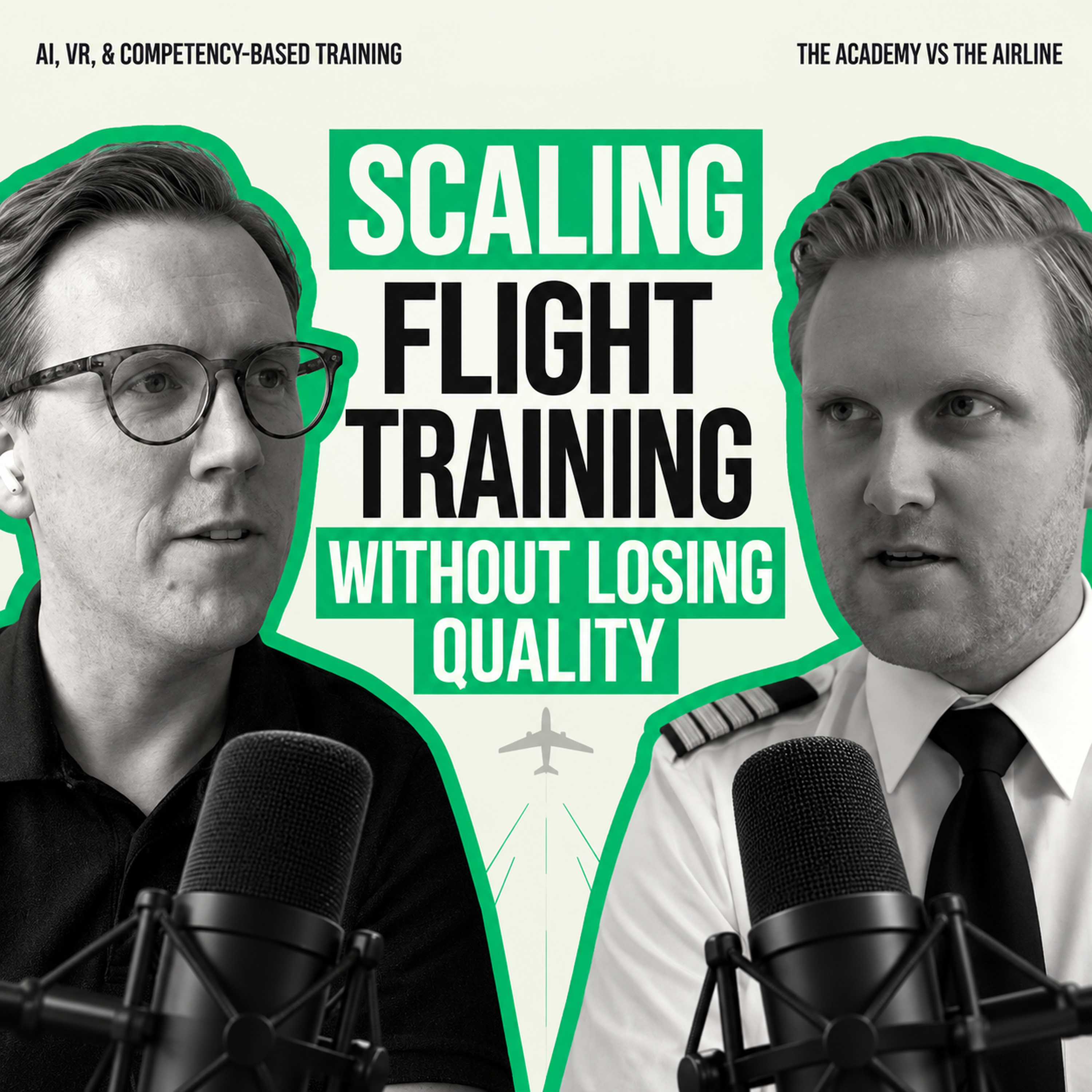
How can a flight school scale without compromising training quality? In the first episode of The Climb, FlightLogger CEO Kasper Valgren speaks with Niklas Algotsson, Head of Training at OSM Aviation Academy, about growth, standardization, data, technology and preparing pilots for the airlines.
Growth is one of the biggest opportunities facing flight training organizations today. But it also creates a difficult operational question:
How do you train more students, hire more instructors and potentially expand across locations without losing the quality and consistency that made the academy successful in the first place?
That is the focus of the first episode of The Climb, FlightLogger's podcast featuring conversations with the people shaping professional flight training.
Host and FlightLogger CEO Kasper Valgren is joined by Niklas Algotsson, Head of Training at OSM Aviation Academy, to discuss what scaling looks like from inside a large flight training organization.
OSM's growth gives Niklas a particularly relevant perspective. He describes an academy that has grown from roughly 50–60 students when he was a student to around 350 across its operations today.
And as Niklas explains, growth changes much more than the numbers.
What happens when a flight school grows?
One of the first things that can disappear as an academy scales is the informal connection between students, instructors and management.
At a smaller academy, conversations in the hallway can give training leaders an intuitive understanding of how students and instructors are doing. As the organization grows, that becomes harder.
Niklas explains that this creates a greater need for the right organizational structure and enough administrative capacity to follow students throughout their education and support instructors.
The challenge becomes even greater when expansion involves multiple bases.
When OSM expanded beyond its established operation, maintaining common procedures, quality and culture required deliberate standardization while still allowing individual bases to operate within different local cultures.
The lesson is simple: what happens naturally in a small organization often needs to become systematic as the organization grows.
How can flight schools maintain quality while scaling?
For Niklas, maintaining quality starts with the people entering the training organization — both students and instructors.
Growing student numbers should not mean lowering the criteria used to determine whether candidates are suited to the program. Niklas warns that abandoning proper student assessment in pursuit of growth can quickly create problems further into training.
Instructor recruitment creates another challenge.
As airlines recruit aggressively, flight schools can find it harder to retain experienced instructors or recruit their strongest graduates into instructional roles. OSM has responded by putting greater emphasis on structured and adaptable instructor training so instructors with different levels of experience can reach a common standard.
That standardization becomes increasingly important as the academy grows.
Why does data matter in modern flight training?
Scaling also changes how training leaders understand performance.
At a smaller academy, instructors and management may know individual students closely enough to rely partly on personal observation. At scale, structured data becomes increasingly important.
Niklas describes how OSM uses training data from FlightLogger to monitor areas such as theory progression, examination attempts, training timeframes and performance across different phases of the program.
This allows the academy to identify patterns rather than simply react to individual cases.
In one example, OSM identified that students were performing strongly in one phase while encountering greater difficulty in another. The academy could then use those results to adjust and fine-tune the training program.
This is where data becomes more than reporting.
It becomes an input for improving the training itself.
Instructor standardization becomes more important as academies grow
Growth doesn't only affect students.
When instructor teams are small, informal communication can help maintain consistency. But that becomes increasingly difficult as the instructor population expands and turnover increases.
OSM therefore uses structured standardization programs, supervision and feedback. Niklas describes how feedback from students, examiners and training outcomes can be fed back into instructor standardization to address areas where students are struggling.
Continuity also matters.
OSM has found ways for instructors who move into airline careers to return in hourly roles, bringing additional airline experience back into the academy while maintaining connections with newer instructors.
What do airlines expect from today's pilot graduates?
According to Niklas, airlines don't necessarily expect more from graduates than they did previously.
They increasingly expect different things.
Technical skill remains fundamental, but attitude, teamwork and competencies are becoming increasingly important in airline assessments.
Niklas describes airline partners paying attention to details ranging from student behavior and attitude to CRM and competency-based performance.
For flight schools, that changes the definition of success.
Passing a skill test is important. But the real outcome is preparing a graduate for the professional environment they are entering.
Niklas puts particular emphasis on looking at whether graduates actually secure their first aviation job — something OSM tracks as an important training outcome.
How is technology changing pilot training?
The modern student's training environment also looks different.
Niklas discusses how tools such as basic simulators and VR can give students opportunities to rehearse procedures and prepare outside formal flight lessons.
But simply making technology available doesn't guarantee that every student benefits equally.
OSM observed that some of its strongest students heavily used available simulator technology and improved even further, while students who were struggling were not necessarily the ones making the greatest use of it.
That creates a new challenge for training organizations:
It's not enough to provide the technology. Students may also need guidance on how to use it effectively.
Could competency-based training change the flight-hour model?
Niklas also sees potential for flight training to become increasingly competency-based.
Rather than progressing purely according to prescribed hours, future training programs could potentially become more dynamic, with progression determined increasingly by whether a student has reached the required competency level.
In that environment, technologies such as VR and simulation could play a larger role and potentially help improve training efficiency while maintaining — or improving — quality.
Where could AI help flight schools?
AI is another area with significant potential.
Niklas sees scheduling as one obvious application. Flight school scheduling involves balancing instructor qualifications, aircraft, students, lesson requirements and numerous operational constraints.
But he also sees a more ambitious possibility.
Imagine an AI-supported training environment that uses instructor input and training records to help determine the most appropriate next lesson for each individual student.
One student's next step might look completely different from another's.
Niklas also points to a much more immediate application: using AI to summarize a student's training history for an instructor before the next lesson.
The longer-term possibility is a training program that becomes increasingly individualized around each student's development.
What should flight schools do before scaling?
At the end of the conversation, Kasper asks Niklas to give one piece of advice to a flight school looking to grow.
His answer captures the central theme of the episode:
Stabilize first. Scale second.
Niklas argues that schools should have control over the existing operation and establish a stable platform before reaching for the next level.
More students, instructors or locations can create growth.
But sustainable growth requires the processes, people, data and training standards underneath them to grow too.
Watch Scaling Flight Training Without Losing Quality
Watch the full conversation with Niklas Algotsson, Head of Training at OSM Aviation Academy, in Episode 1 of The Climb.
The Climb — conversations from the world's most ambitious flight schools.