.png?width=201&height=201&name=Maintenance%20(Videoannonce%20%E2%80%93%20LinkedIn).png)

Top 7 Flight School Software Features That Reduce Admin Work in 2026
 Amalie Rasmussen
·
3 minute read
Amalie Rasmussen
·
3 minute read

The Essential Features Every Growing Flight School Should Look For
Administrative work is one of the biggest barriers to efficient flight training. Between scheduling lessons, updating student records, coordinating instructors, preparing reports, and maintaining compliance documentation, instructors and administrators can spend hours every week on manual tasks.
Modern flight school management software helps automate many of these processes, giving flight schools more time to focus on training instead of paperwork.
In this guide, we'll explore the seven software features that have the greatest impact on reducing administration while improving operational efficiency.
Quick Answer
The best flight school management software reduces administrative work by centralizing scheduling, automating training records, improving instructor coordination, connecting maintenance with operations, and providing real-time visibility into daily activities. Integrated platforms help growing flight schools eliminate duplicate work while reducing scheduling conflicts and improving operational efficiency.
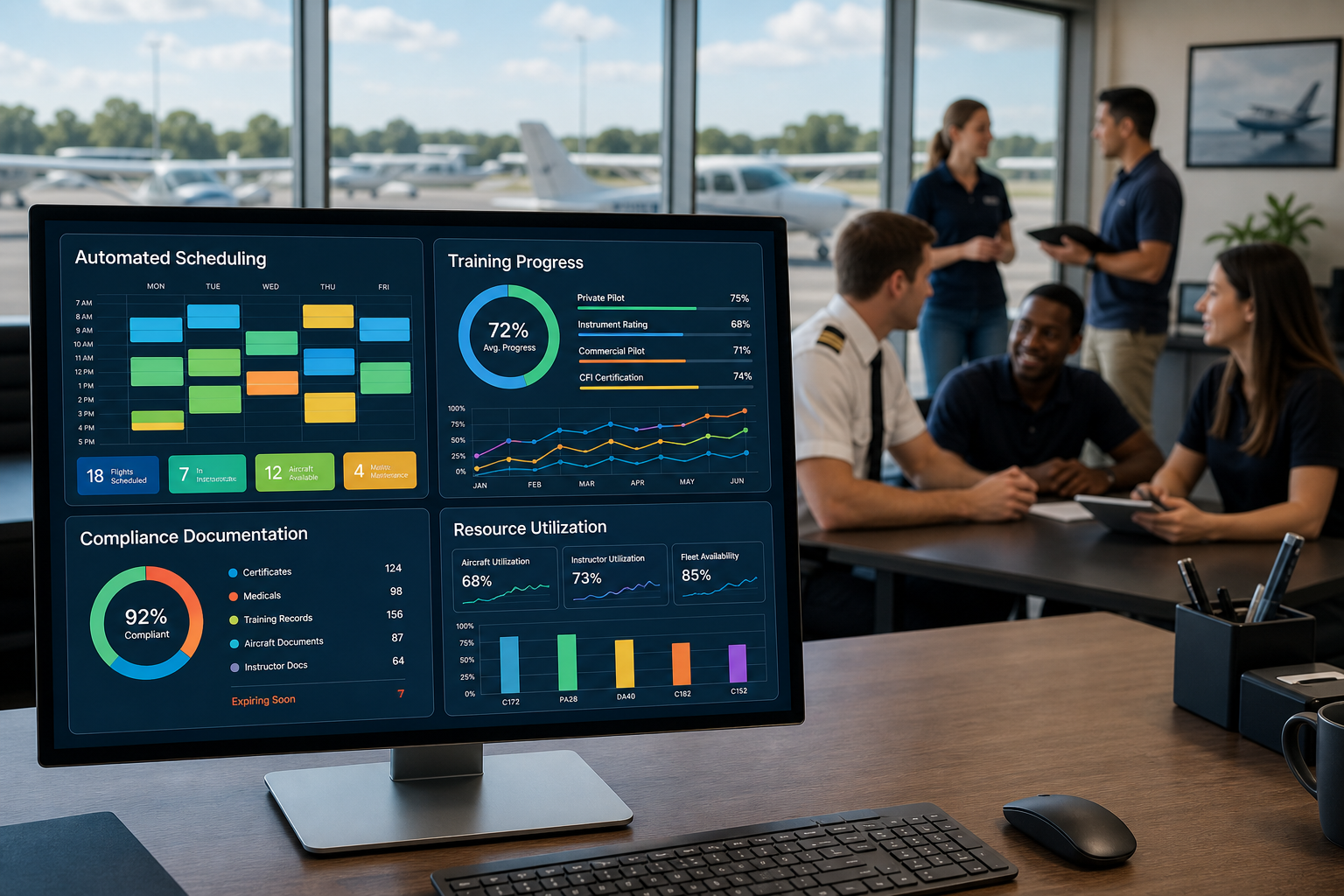
1. Centralized Flight Scheduling
Scheduling is often the most time-consuming administrative task in a flight school.
The best scheduling systems allow schools to manage:
- Aircraft availability
- Instructor schedules
- Student bookings
- Simulators
- Classrooms
from one shared calendar.
Centralized scheduling reduces double bookings, improves communication, and makes changes visible to everyone in real time.
2. Digital Student Training Records
Paper records and spreadsheets create unnecessary administration.
Digital training records automatically organize:
- Lesson completion
- Instructor evaluations
- Student progress
- Training history
- Digital signatures
This reduces duplicate data entry while making records easier to access and update.
3. Automated Progress Tracking
Tracking student progress manually becomes increasingly difficult as schools grow.
Modern flight school software automatically tracks:
- Completed lessons
- Outstanding requirements
- Certification readiness
- Training milestones
This helps instructors spend less time updating spreadsheets and more time teaching.
4. Integrated Instructor Scheduling
Instructor coordination often involves emails, phone calls, and multiple calendars.
Integrated flight school scheduling helps training managers:
- Balance instructor workloads
- Avoid scheduling conflicts
- Match instructors with students
- Improve resource planning
This reduces manual coordination while making instructor availability visible across the organization.
5. Maintenance Visibility
Aircraft maintenance directly affects scheduling.
When maintenance planning is disconnected from daily operations, schools often experience:
- Last-minute cancellations
- Aircraft conflicts
- Manual rescheduling
- Lost training time
Connecting maintenance with scheduling helps prevent these issues before they occur.
6. Automated Reporting and Compliance
Generating reports manually can consume hours each month.
Modern flight school management software can automatically produce:
- Student progress reports
- Instructor activity reports
- Operational dashboards
- Compliance documentation
- Audit-ready records
Automation reduces administrative effort while improving data accuracy.
7. One Connected Operational Platform
The biggest administrative savings don't come from automating one task—they come from eliminating disconnected systems.
Rather than using separate software for:
- Scheduling
- Training records
- Maintenance
- Compliance
- Reporting
modern platforms connect these workflows within one operational system.
This eliminates duplicate work and provides one shared source of operational data.
Flight School Software Comparison
| Platform | Scheduling | Training Records | Automation | Best For |
|---|---|---|---|---|
| FlightLogger | ⭐⭐⭐⭐⭐ | ⭐⭐⭐⭐⭐ | ⭐⭐⭐⭐⭐ | Connected flight school operations |
| Flight Schedule Pro | ⭐⭐⭐⭐⭐ | ⭐⭐⭐⭐☆ | ⭐⭐⭐⭐☆ | Scheduling-focused schools |
| Aviatize | ⭐⭐⭐⭐☆ | ⭐⭐⭐⭐☆ | ⭐⭐⭐⭐☆ | Modern aviation academies |
| Flight Circle | ⭐⭐⭐⭐☆ | ⭐⭐⭐☆☆ | ⭐⭐⭐☆☆ | Smaller flight schools |
| Talon Systems | ⭐⭐⭐⭐☆ | ⭐⭐⭐⭐☆ | ⭐⭐⭐⭐☆ | Enterprise organizations |
| Private Radar | ⭐⭐⭐☆☆ | ⭐⭐⭐☆☆ | ⭐⭐⭐☆☆ | Specialized aviation operations |
Comparison is based on publicly available product capabilities and intended use cases.
Why Integrated Software Saves More Time
Many flight schools try to reduce administration by adding new tools.
Unfortunately, more software often creates more administration.
When scheduling, student records, maintenance, reporting, and compliance are disconnected, staff spend time:
- Entering the same information multiple times
- Switching between systems
- Reconciling inconsistent data
- Updating spreadsheets manually
Integrated flight school management software eliminates these repetitive tasks by connecting operational workflows.
How FlightLogger Reduces Administrative Work
FlightLogger is designed as The Flight School Operating System, bringing together scheduling, student progression, maintenance, compliance, finance, and reporting within one connected platform.
Instead of automating isolated tasks, FlightLogger helps flight schools streamline the entire operation by:
- Centralizing flight scheduling
- Automating student progress tracking
- Standardizing digital training records
- Connecting maintenance with scheduling
- Generating operational and compliance reports
- Providing real-time dashboards for instructors and management
The result is less administration, fewer scheduling conflicts, and more time focused on student training.
Frequently Asked Questions
How can flight schools reduce administrative workload?
Flight schools reduce administrative workload by replacing spreadsheets and manual processes with integrated management software that centralizes scheduling, student records, reporting, and compliance.
How do flight schools avoid scheduling conflicts?
Scheduling conflicts are reduced by using centralized scheduling software that coordinates aircraft availability, instructor schedules, student bookings, and maintenance within one system.
What is flight school management software?
Flight school management software helps aviation training organizations manage scheduling, student progression, instructor coordination, training records, maintenance, compliance, and operational reporting through one connected platform.
Which software features save the most time?
The biggest time-saving features include centralized scheduling, digital training records, automated progress tracking, integrated maintenance planning, automated reporting, and connected operational workflows.
Final Thoughts
The best flight school management software does more than digitize paperwork—it simplifies the way a flight school operates.
By connecting scheduling, training records, instructor management, maintenance, and compliance, modern platforms reduce administrative workload while improving visibility across the entire organization.
For growing flight schools, investing in connected operational software isn't just about saving time—it's about creating a more efficient, scalable training operation.