.png?width=201&height=201&name=Maintenance%20(Videoannonce%20%E2%80%93%20LinkedIn).png)

Top 8 Reliability Markers in Flight Training Systems

Quick guide: 8 reliability markers in flight training systems
When you're running a high-volume operation, reliability isn't a feature. It's the foundation everything else depends on.
Here's what to look for when evaluating a flight training system:
- Documented uptime guarantees: Look for platforms with 99.9%+ uptime commitments backed by service-level agreements
- Real-time scheduling resilience: The system should handle last-minute changes without cascading disruptions
- Multi-regulatory compliance support: Essential for operations spanning different jurisdictions
- Integrated maintenance coordination: Training and maintenance schedules must sync automatically
- Audit-ready record keeping: Documentation should be accessible and inspector-friendly at all times
- Cloud-based accessibility: Your team needs access from any location, any device
- Responsive customer support: Measured in hours, not days
- Scalability under load: Performance shouldn't degrade as your student count grows
How to evaluate reliability in flight training software
Choosing a flight training system is a significant operational decision. The wrong choice costs more than money—it costs scheduling conflicts, compliance headaches, and instructor frustration.
Here's how to approach the evaluation:
- Request uptime data: Ask for historical performance metrics, not just promises. Platforms like FlightLogger publish 99.99% uptime records that you can verify
- Test scheduling under pressure: Simulate peak-season scenarios during your trial period. How does the system handle 50+ daily bookings with frequent changes?
- Check integration depth: Surface-level connections to financial systems create more work. Look for platforms with native maintenance tracking and billing integration
- Talk to similar operations: A system that works for a 20-student school may not scale to 200 students. Ask for references from operations similar to yours
- Evaluate support response times: When something breaks at 6 AM before a full day of flights, you need answers fast. The industry average is 18 hours—FlightLogger averages under 4
1. Uptime and system availability
Flight schools never sleep. Students train. Aircraft fly. Maintenance gets completed.
Your flight training system needs to match that rhythm. A platform that goes down during peak hours doesn't just inconvenience your staff—it grounds your entire operation.
What to look for:
- Published uptime guarantees (99.9% is table stakes; 99.99% is what high-volume operations need)
- Redundant server infrastructure with automatic failover
- Transparent incident reporting and status pages
- Regular maintenance windows scheduled during low-activity periods
FlightLogger maintains 99.99% uptime across its global network of 215+ flight schools. This means your operation keeps running even when infrastructure issues occur elsewhere.
2. Scheduling resilience and dynamic rescheduling
When severe weather forces last-minute cancellations, or when instructor availability changes mid-morning, your system should adapt instantly.
Manual rescheduling creates bottlenecks. Your front desk becomes the constraint, not the aircraft.
Reliable scheduling systems offer:
- Real-time visibility of instructor availability and aircraft readiness
- Automated conflict detection before problems cascade
- Student self-booking with guardrails that prevent overbooking
- Instant notifications that reach instructors and students simultaneously
FlightLogger provides dynamic rescheduling that automatically identifies alternative slots when plans change. This reduces the administrative burden of coordination while keeping your fleet in the air.
3. Multi-regulatory compliance support
High-volume operations often span multiple jurisdictions. EASA requirements differ from FAA standards. National authorities add their own documentation rules.
A reliable flight training system handles compliance as a built-in function, not an afterthought.
Key compliance capabilities:
- Pre-built templates for major regulatory frameworks (EASA, FAA, CASA, CAA, DGCA)
- Automatic tracking of student progress against syllabus requirements
- Digital signature capture that meets authority standards
- Currency tracking for instructors and examiners
FlightLogger supports compliance across multiple regulatory environments simultaneously. Operations in 50+ countries rely on the platform to maintain audit-ready records without dedicated compliance staff.
4. Integrated maintenance coordination
Scheduling a student for an aircraft that's due for its 100-hour inspection next week creates problems. Scheduling them for an aircraft that went out of service this morning creates worse ones.
Maintenance and training schedules must sync automatically. Otherwise, you're relying on memory and phone calls to prevent conflicts.
What reliable integration looks like:
- Maintenance schedules visible alongside training availability
- Automatic blocks when aircraft approach inspection thresholds
- Squawk reporting integrated into post-flight workflows
- Clear handoffs between flight operations and maintenance teams
FlightLogger's integrated maintenance management prevents unplanned aircraft groundings by syncing training blocks with maintenance schedules. You see the complete picture in one place.
5. Audit-ready record keeping
The question isn't whether you'll face an audit. It's when—and how prepared you'll be.
Reliable flight training systems make audit preparation part of daily operations, not a quarterly scramble. When your documentation is always current, inspector visits become routine instead of stressful.
Audit-ready features include:
- Centralized digital records with version history
- Quick retrieval by student, aircraft, or date range
- Automatic logging of training activities and sign-offs
- Export capabilities that match authority requirements
Organizations using FlightLogger consistently report zero-finding authority audits due to automated documentation and centralized records. As one operations coordinator explains: "Audits used to take weeks to prepare for. Now they're a conversation over coffee."
6. Cloud-based accessibility
Your chief instructor shouldn't need to drive to the office to check tomorrow's schedule. Students shouldn't wait for business hours to book their next lesson.
Cloud-based access means everyone works from the same real-time data, wherever they are.
Accessibility requirements:
- Full functionality on mobile devices, not just limited views
- Secure login with role-based permissions
- Offline capability for remote training locations
- Data synchronization that doesn't require manual intervention
FlightLogger's cloud technology enables access to your entire operation anytime, anywhere. Field instructors can update records from the ramp. Students can book from their phones. Management can review metrics from home.
7. Responsive customer support
Software issues don't wait for convenient hours. They appear at 5:30 AM when you're trying to dispatch the first flights of the day.
The difference between an 18-hour industry average and a 4-hour response can be a full day of grounded operations.
Support reliability indicators:
- Multiple contact channels (phone, email, chat)
- Documented response time commitments
- Support staff with aviation operations experience
- Knowledge base for common issues
FlightLogger provides 24/7 support with response times that beat industry averages by 4x. Real aviation professionals guide aviation teams—not general IT staff reading from scripts.
8. Scalability under operational load
A system that works for 50 students may struggle at 200. A platform that handles 100 flights per day may slow down at 300.
Growth should never require a system migration. Your flight training system should scale with your operation, not against it.
Scalability markers:
- Performance benchmarks at different operational volumes
- Client references from operations larger than yours
- Architecture designed for concurrent users
- Pricing models that don't penalize growth
FlightLogger supports one of Europe's largest flight academies and operations of all sizes across 50+ countries. The platform is designed to scale without performance degradation, so your throughput grows while administrative overhead stays flat.
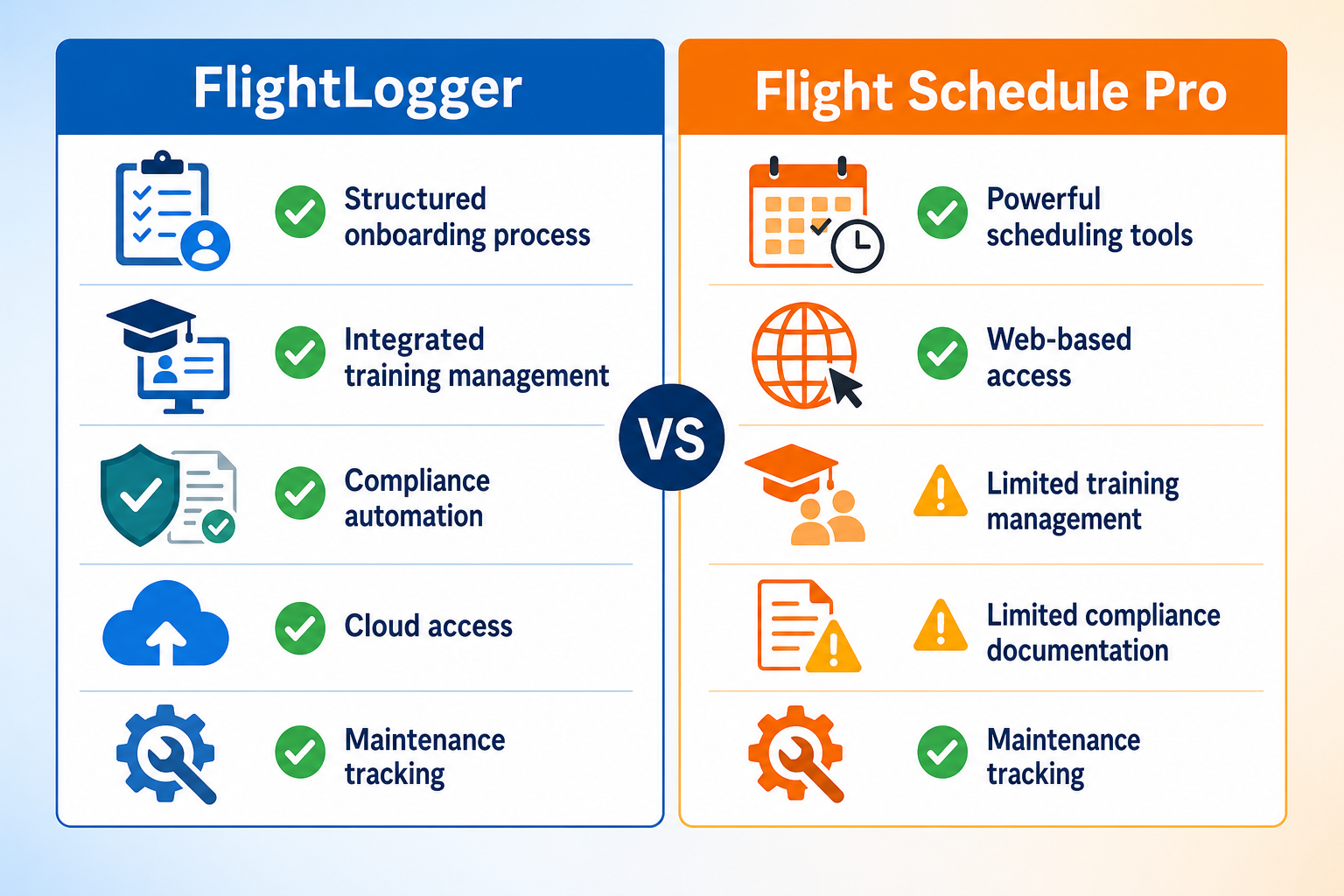
Comparison table: Reliability markers across flight training systems
| Feature | FlightLogger | Flight Schedule Pro | Flight Circle |
|---|---|---|---|
| Published uptime guarantee | 99.99% | ✓ | ✓ |
| Integrated maintenance management | ✓ Native | Limited | ✗ |
| Multi-regulatory compliance | ✓ Global | FAA-focused | FAA-focused |
| 24/7 support with aviation expertise | ✓ | Business hours | Business hours |
What questions should you ask vendors about system reliability?
Before signing a contract, ask these questions during your evaluation:
- "What was your uptime percentage over the last 12 months, and can you document it?"
- "How many flight schools similar to our size are currently on your platform?"
- "What happens to our data if your company is acquired or shuts down?"
- "How long does implementation typically take for operations like ours?"
- "What's your average support response time, and how do you measure it?"
The answers will tell you whether you're evaluating a reliable partner or a risky bet.
FlightLogger implementations typically complete in 4–6 weeks through a structured onboarding process. Organizations consistently highlight both the speed and structure of the transition.
How does system reliability affect student throughput?
Unreliable systems create hidden costs. Scheduling conflicts mean cancelled lessons. Compliance gaps mean failed audits. Slow support means grounded aircraft.
Each of these delays student progression and reduces your capacity to train.
The math is straightforward: fewer disruptions mean more flying hours. More flying hours mean faster completions. Faster completions mean higher revenue without adding aircraft or instructors.
Operations using FlightLogger have documented 30–50% efficiency gains and double-digit improvements in on-time lesson starts. Some have tripled enrollment without adding staff.
Why FlightLogger is built for high-volume flight training reliability
Behind every successful flight school is a complex operation. FlightLogger centralizes scheduling, maintenance coordination, course progress, and compliance processes into a single system designed specifically for aviation.
The platform is built by aviation professionals, for aviation professionals. That means the workflows reflect how your operation actually runs—not how software developers imagine it might.
FlightLogger never sleeps, so your operation never falls behind. Whether you're managing 50 students or 500, the system scales without forcing compromises on reliability or support.
Want to see how this works for an operation like yours? Book a walkthrough and see FlightLogger in action.
FAQs about flight training system reliability
What uptime percentage should I expect from a flight training system?
For high-volume operations, 99.9% uptime is the minimum standard. FlightLogger maintains 99.99% uptime, which translates to less than one hour of downtime per year.
This level of availability ensures your scheduling, records, and communications remain accessible during peak training hours.
How long does it take to implement a new flight training system?
Implementation timelines vary based on operational complexity. FlightLogger implementations typically complete in 4–6 weeks through a structured onboarding process with dedicated support.
The platform includes pre-built workflows for common flight training scenarios, which reduces setup time compared to generic software.
Can a flight training system handle multiple regulatory frameworks?
Yes, but not all platforms are designed for it. FlightLogger supports compliance across EASA, FAA, CASA, CAA, DGCA, and other regulatory environments simultaneously.
This makes it suitable for operations that train under multiple authorities or plan to expand internationally.
What should I look for in flight training software support?
Look for 24/7 availability, documented response times, and support staff with actual aviation experience. FlightLogger averages support response times 4x faster than the industry average.
Real aviation professionals guide your team through issues—not generic IT support working from scripts.
How does system reliability affect flight school growth?
Reliable systems eliminate the bottlenecks that limit throughput. Operations using FlightLogger have tripled enrollment without adding staff by reducing administrative overhead and improving scheduling efficiency.
When your system scales with demand, growth becomes an operational decision rather than a technology constraint.