.png?width=201&height=201&name=Maintenance%20(Videoannonce%20%E2%80%93%20LinkedIn).png)

10 Flight School Data Silos Slowing Down Your Operations
 Amalie Rasmussen
·
4 minute read
Amalie Rasmussen
·
4 minute read
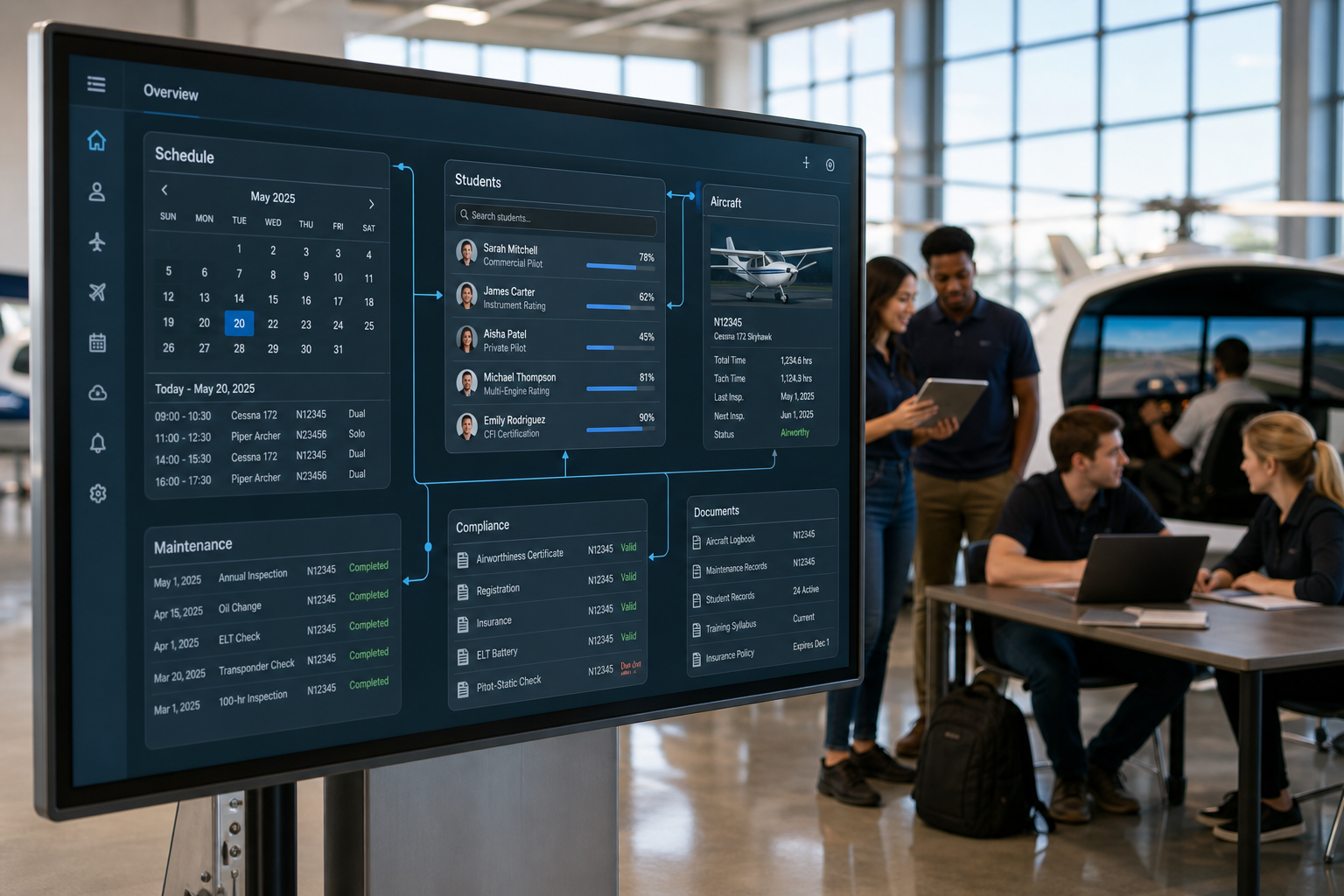
Disconnected systems make it harder to schedule lessons, monitor student progress, maintain compliance, and make informed decisions. Learn which data silos to eliminate first to build a more efficient, digital flight school.
Quick Answer
Successful flight school digitization isn't just about replacing paper with software—it's about connecting information across your organization. Eliminating data silos between scheduling, training records, maintenance, compliance, and student management helps improve operational visibility, reduce administrative work, and create a more efficient flight school.
What Are Data Silos?
A data silo exists when important information is stored in one place but isn't easily accessible to the people or systems that need it.
In many flight schools, information lives across:
- Paper records
- Spreadsheets
- Scheduling software
- Maintenance systems
- Shared drives
- Individual instructor notes
Each system may work independently, but together they create extra administration, duplicate work, and operational blind spots.
Why Data Silos Hurt Flight School Operations
Disconnected information affects every department.
Common consequences include:
- Double data entry
- Scheduling delays
- Inconsistent student records
- Limited operational reporting
- Slower audit preparation
- Poor communication between departments
- Reduced resource utilization
The larger the flight school becomes, the more expensive these inefficiencies become.
1. Student Records Separate from Scheduling
If student progress is stored separately from scheduling, administrators must manually determine which lesson should come next.
Eliminate the silo
Connect student records directly with scheduling.
Result: Students are scheduled according to their actual training progress.
2. Flight and Ground Training in Different Systems
Managing separate syllabi creates duplicated administration and fragmented student journeys.
Eliminate the silo
Use one integrated training program covering both flight and ground instruction.
Result: Better continuity and simpler training management.
3. Instructor Qualifications Stored Elsewhere
Scheduling instructors without visibility into qualifications or currency increases administrative effort and the risk of assignment errors.
Eliminate the silo
Link instructor qualifications with scheduling.
Result: Better instructor utilization and easier compliance.
4. Maintenance Separate from Operations
Aircraft maintenance directly impacts scheduling.
If maintenance information isn't connected to operational planning, aircraft may be booked when unavailable.
Eliminate the silo
Integrate maintenance visibility with operational scheduling.
Result: More reliable aircraft availability and fewer disruptions.
5. Compliance Records Stored Independently
Audit documentation often lives in folders, spreadsheets, and email chains.
Finding everything during an inspection becomes time-consuming.
Eliminate the silo
Centralize compliance documentation within daily operational workflows.
Result: Faster audit preparation and stronger regulatory oversight.
6. Instructor Notes Hidden in Personal Documents
Many instructors maintain their own notes outside the school's primary systems.
This limits collaboration and continuity.
Eliminate the silo
Record lesson notes and assessments in shared digital training records.
Result: Better communication and standardized instruction.
7. Reporting Based on Manual Data Collection
If managers must gather data from multiple systems before creating reports, reporting becomes slow and often outdated.
Eliminate the silo
Use software that automatically generates operational dashboards.
Result: Better decisions based on current operational data.
8. Resource Planning Separate from Training
Aircraft, simulators, instructors, and classrooms all influence training delivery.
Managing them independently reduces efficiency.
Eliminate the silo
Plan resources alongside curriculum and scheduling.
Result: Improved resource utilization and fewer bottlenecks.
9. Communication Across Multiple Platforms
Important operational updates often move through email, messaging apps, spreadsheets, and paper notices.
This creates inconsistent information across teams.
Eliminate the silo
Centralize operational information in one platform.
Result: Everyone works from the same data.
10. Management Without Operational Visibility
When leaders cannot see scheduling performance, student progression, instructor workload, compliance status, and aircraft utilization in one place, planning becomes reactive.
Eliminate the silo
Adopt a connected flight school management system with organization-wide reporting.
Result: Better strategic planning and more efficient daily operations.
Benefits of Eliminating Data Silos
Removing disconnected workflows helps flight schools:
- Improve scheduling efficiency
- Reduce duplicate administration
- Increase instructor productivity
- Improve aircraft utilization
- Accelerate student progression
- Strengthen compliance
- Improve reporting accuracy
- Scale operations more effectively
Digitization delivers the greatest value when information flows seamlessly across the organization.
Disconnected Systems vs Connected Flight School Management
| Disconnected Systems | Connected Flight School Management |
|---|---|
| Multiple spreadsheets | Centralized operational platform |
| Separate student records | Connected student lifecycle |
| Manual scheduling decisions | Scheduling linked to training progress |
| Independent maintenance tracking | Maintenance visibility within scheduling |
| Separate compliance documentation | Continuous compliance workflows |
| Manual reporting | Live operational dashboards |
| Department-specific data | Shared operational visibility |
Compare Flight School Management Platforms
Several platforms help flight schools reduce data silos and digitize operations.
| Platform | Best For | Key Strengths |
|---|---|---|
| FlightLogger | Flight schools seeking a complete Flight School Operating System | Connected scheduling, integrated syllabi, digital training records, compliance, maintenance visibility, reporting |
| Flight Schedule Pro | Scheduling-focused schools | Scheduling and student management |
| Aviatize | Growing flight schools | Training administration and operational workflows |
| Flight Circle | Smaller flight schools | Scheduling and student administration |
| Talon Systems | Larger organizations | Training administration and compliance |
| Tailplane | Scheduling-focused operations | Resource planning and scheduling |
The right platform depends on whether you're simply digitizing individual processes or building a connected operational environment where every department shares the same information.
Frequently Asked Questions
What are data silos in a flight school?
Data silos occur when information is stored in separate systems that don't communicate with each other. Common examples include separate scheduling software, paper training records, maintenance systems, and compliance documentation.
Why is eliminating data silos important?
Removing data silos improves scheduling, student progression, compliance, reporting, and communication while reducing duplicate data entry and administrative work.
What is flight school digitization?
Flight school digitization is the process of replacing manual, paper-based, and disconnected workflows with integrated digital systems that support training, scheduling, maintenance, compliance, and reporting.
How can a flight school management system reduce data silos?
A modern flight school management system centralizes operational data, allowing scheduling, training records, compliance, maintenance, instructor management, and reporting to work together within one platform.
Build a Connected Digital Flight School
The goal of digitization isn't simply to replace paper—it's to connect every part of your operation.
When scheduling, training records, compliance, maintenance, instructor management, and reporting share the same data, your team spends less time moving information between systems and more time delivering exceptional flight training.
As the Flight School Operating System, FlightLogger helps flight schools eliminate data silos by bringing every critical operational workflow into one connected platform. The result is greater visibility, better coordination, and a more efficient training organization.