.png?width=201&height=201&name=Maintenance%20(Videoannonce%20%E2%80%93%20LinkedIn).png)

10 Availability Data Lessons Every Flight School Should Apply in 2026

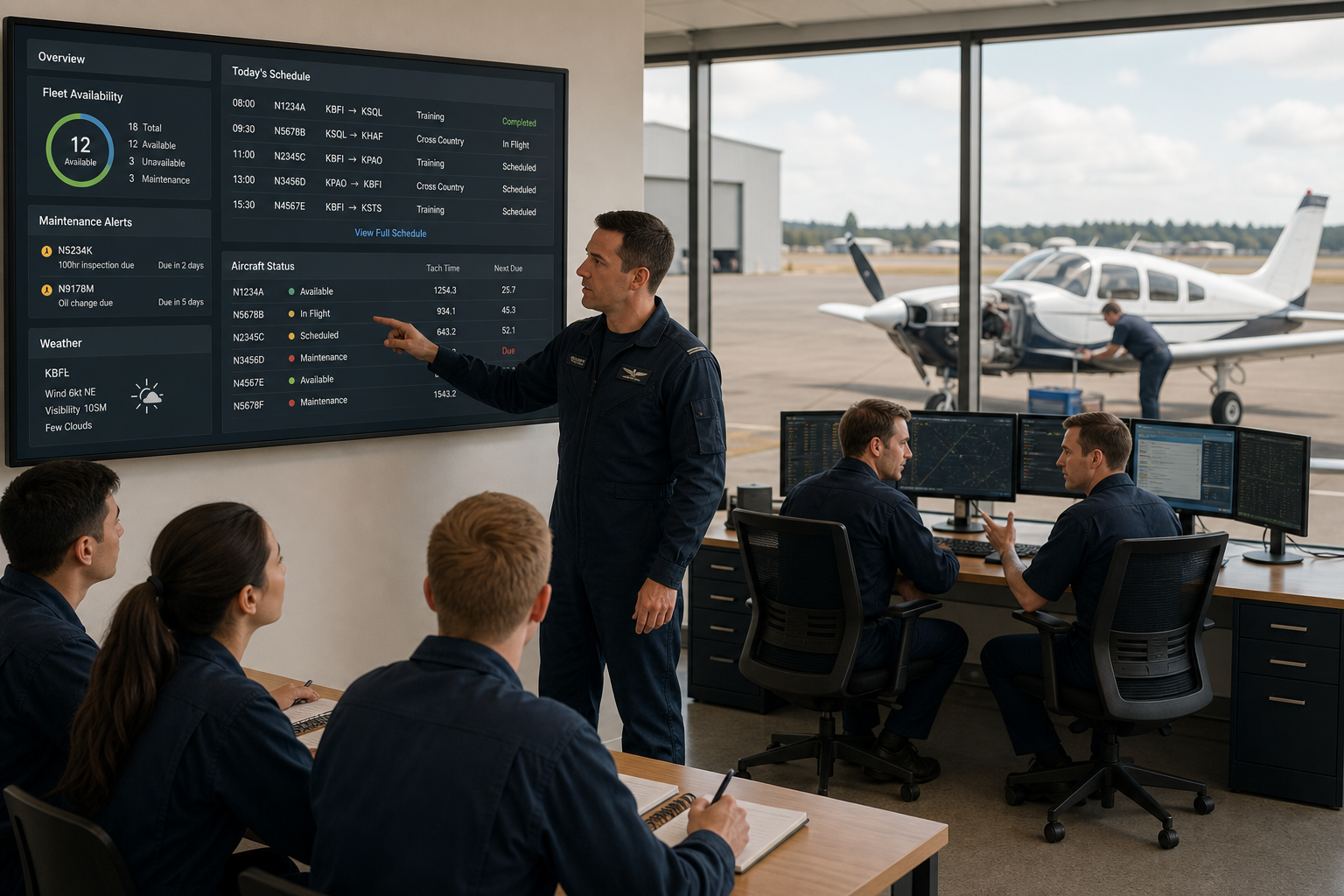
How Real-Time Availability Improves Flight School Efficiency
Every lesson depends on one simple question:
Is everything available when it needs to be?
That means more than just having an aircraft on the ramp. A successful flight requires the right instructor, the right aircraft, the right student, and the right point in the training syllabus—all available at the same time.
Many flight schools still manage this information across spreadsheets, whiteboards, emails, and separate systems. The result is delayed decisions, scheduling conflicts, and unnecessary administrative work.
Modern flight school management relies on real-time operational data to coordinate resources across the entire organization.
This guide explores ten lessons flight schools can apply to improve scheduling decisions, reduce delays, and increase operational efficiency through better availability data.
Why Availability Data Matters
Availability isn't simply a scheduling problem.
It's an operational visibility problem.
Every day, flight schools need to know:
- Which aircraft are available?
- Which instructors are available?
- Which students are ready for training?
- Which aircraft require maintenance?
- Which instructors are qualified for specific lessons?
- Which students are approaching training milestones?
Without current information, every scheduling decision becomes more difficult.
1. Availability Should Be Updated in Real Time
The value of availability data depends on how current it is.
An instructor who became unavailable this morning...
An aircraft that entered maintenance this afternoon...
A student who completed a stage check earlier than expected...
These operational changes should immediately be reflected across the organization.
Real-time updates reduce unnecessary rescheduling and improve planning.
2. Aircraft Availability Is More Than "Available" or "Unavailable"
Aircraft availability constantly changes.
Operational teams should have visibility into:
- Scheduled flights
- Maintenance windows
- Inspection requirements
- Temporary restrictions
- Aircraft status
- Fleet utilization
This allows schedulers to make informed decisions before conflicts occur.
3. Instructor Availability Includes Qualifications
Not every instructor can teach every lesson.
Effective scheduling considers:
- Instructor availability
- Ratings and qualifications
- Student continuity
- Training stage
- Workload
Matching the right instructor with the right lesson improves both operational efficiency and training quality.
4. Student Readiness Should Influence Scheduling
Scheduling should reflect where students are in their training—not simply who is available.
Training leaders should consider:
- Completed lessons
- Competencies achieved
- Upcoming stage checks
- Check ride preparation
- Outstanding prerequisites
Connecting student progression with scheduling helps reduce unnecessary delays.
5. Maintenance Should Be Visible to Operations
Maintenance planning directly affects aircraft availability.
If maintenance information isn't shared with scheduling teams, schools risk:
- Cancelled lessons
- Instructor downtime
- Student delays
- Reduced fleet utilization
Connected flight training operations ensure maintenance becomes part of scheduling—not a disruption to it.
6. Visibility Across Departments Prevents Delays
Availability data shouldn't belong to one department.
Operations, instructors, dispatch, maintenance, administration, and leadership all rely on the same information.
A shared operational view improves communication while reducing manual coordination.
7. Availability Data Helps Predict Bottlenecks
Real-time visibility isn't only useful today.
Historical availability data helps schools identify:
- Frequently overbooked aircraft
- Instructor capacity constraints
- Peak training periods
- Fleet utilization trends
- Scheduling bottlenecks
These insights support better operational planning.
8. Standardized Availability Improves Flight School Administration
Consistent operational data reduces administrative work.
Instead of manually confirming availability across multiple systems, administrators can access one centralized operational view.
This improves flight school administration by reducing:
- Duplicate communication
- Manual updates
- Scheduling errors
- Administrative workload
9. Availability Data Improves Aviation Training Optimization
Operational optimization isn't about flying more hours.
It's about using available resources more effectively.
Connected availability data helps schools:
- Increase aircraft utilization
- Improve instructor productivity
- Reduce student waiting time
- Recover from disruptions faster
- Improve scheduling decisions
This creates measurable improvements in aviation training optimization.
10. Connected Availability Supports Better Decisions
Availability data becomes significantly more valuable when it's connected.
Instead of viewing aircraft, instructors, students, and operations separately, leadership gains one operational picture.
Better visibility leads to:
- Faster decisions
- Better resource allocation
- Improved operational consistency
- Fewer scheduling conflicts
- Higher training throughput
The most efficient schools don't simply collect operational data.
They act on it.
How Flight Schools Improve Efficiency with Better Availability Data
The most efficient organizations consistently:
- Maintain real-time availability
- Connect aircraft with scheduling
- Link instructor qualifications to lessons
- Track student progression continuously
- Integrate maintenance planning
- Monitor operational dashboards
- Reduce manual communication
- Standardize operational workflows
Together, these practices create a more predictable and efficient training operation.
How Flight School Management Software Supports Operational Visibility
Modern flight school management software connects availability across the entire organization.
Instead of managing scheduling, student records, instructor availability, and reporting separately, schools manage everything from one platform.
A connected system brings together:
- Flight scheduling software
- Student progression
- Instructor management
- Aircraft availability
- Compliance
- Reporting
- Operational insights
- Business analytics
This gives operations teams real-time visibility while reducing administrative effort.
Frequently Asked Questions
How do flight schools improve operational efficiency?
Flight schools improve operational efficiency by coordinating aircraft, instructors, students, maintenance, and scheduling through one connected operational platform. Real-time visibility helps reduce delays, improve resource utilization, and support better decision-making.
Why is real-time availability important in flight training?
Real-time availability allows flight schools to make scheduling decisions using current information rather than outdated spreadsheets or manual updates. This reduces scheduling conflicts, improves aircraft utilization, and helps keep student training on schedule.
What information should flight schools track?
Flight schools should continuously monitor:
- Aircraft availability
- Instructor availability
- Student progression
- Maintenance status
- Resource utilization
- Training milestones
- Operational performance
Together, these provide the visibility needed to manage training efficiently.
How does flight scheduling software improve efficiency?
Modern flight scheduling software connects aircraft, instructors, students, and operational workflows into one system. This reduces manual administration, improves communication, and helps operations teams make faster, more informed scheduling decisions.
What is operational visibility in a flight school?
Operational visibility is the ability to see the current status of training, resources, scheduling, and operations in real time. It allows leadership and operations teams to identify bottlenecks, allocate resources effectively, and maintain training continuity.
Better Availability Creates Better Flight School Operations
Operational efficiency isn't achieved by working harder.
It's achieved by making better decisions with better information.
When instructors, aircraft, students, maintenance, and scheduling are connected through real-time availability data, flight schools reduce delays, improve coordination, and keep training moving without unnecessary administrative effort.
That's the principle behind FlightLogger.
Trusted by 220+ flight schools in more than 50 countries, FlightLogger is the Flight School Operating System that connects scheduling, training, compliance, safety, finance, reporting, and operational insights into one platform. Instead of relying on disconnected tools, every department works from the same real-time operational data—helping schools improve efficiency, reduce scheduling conflicts, and scale with confidence.
Book a demo to see how FlightLogger helps flight schools turn real-time operational visibility into better scheduling decisions and more efficient training operations.