.png?width=201&height=201&name=Maintenance%20(Videoannonce%20%E2%80%93%20LinkedIn).png)

How Flight School Management Software Works in 2026
 Amalie Rasmussen
·
4 minute read
Amalie Rasmussen
·
4 minute read

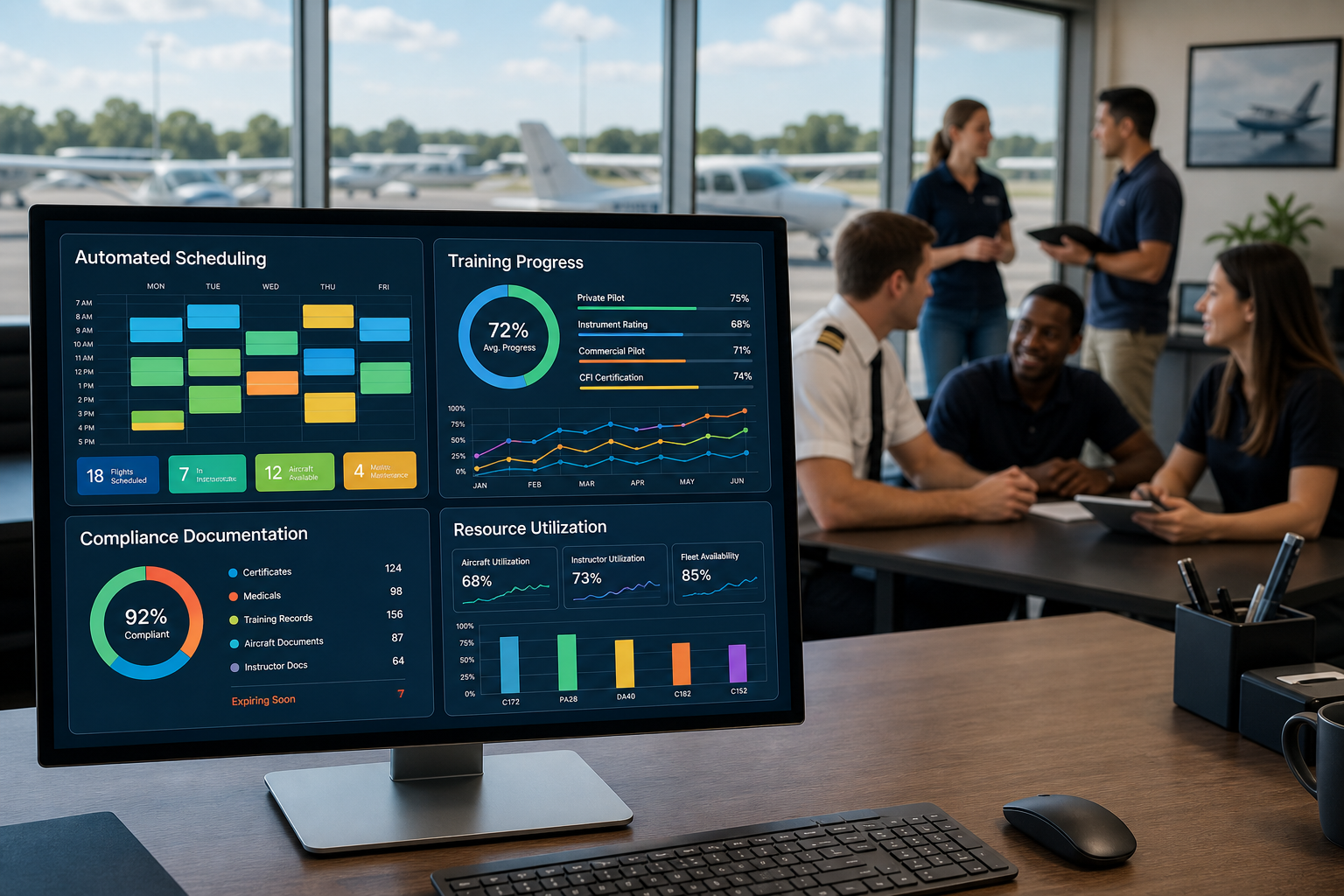
Flight school management software works by connecting every part of a flight school's operation in one system: student training, scheduling, instructors, aircraft, maintenance, compliance, billing, and reporting. When an instructor logs a completed lesson, the software automatically updates the student's training record and progress, the aircraft's hours and maintenance status, the instructor's log, and billing, so nothing has to be entered twice. FlightLogger, used by more than 220 flight schools in 50+ countries, is an example of this kind of platform.
How it works in 5 steps:
- The school sets up its training programs: syllabi, lessons, and competencies for each course.
- Lessons are scheduled against real availability: the student's progress, an available instructor, and an airworthy aircraft.
- The instructor logs and grades the lesson right after the flight.
- Everything updates automatically: training records, flight hours, aircraft maintenance status, and billing.
- Managers see it all in real time, from student progression to fleet utilization and compliance status.
This guide explains each part of the system and what to look for when choosing one.
Why Flight Schools Need More Than Scheduling Software
Years ago, most aviation software focused on one task—usually scheduling.
Today, flight schools operate much more like complex service organizations. Every lesson depends on multiple factors working together:
- Is the student ready for the lesson?
- Is the assigned instructor available?
- Is the aircraft airworthy?
- Does the lesson match the student's syllabus?
- Are training records up to date?
- Will maintenance affect availability?
Managing these questions manually quickly becomes difficult as schools grow.
Modern flight school management software connects these processes instead of treating them as separate tasks.
How Flight School Management Software Works
Rather than acting as individual modules, modern platforms connect every operational area into a continuous workflow.
1. Student Training Management
Everything starts with the student's training journey.
The software manages:
- Training programs
- Syllabi
- Competencies
- Flight lessons
- Ground school
- Assessments
- Student progression
As lessons are completed, progress is automatically updated, giving instructors and training managers a clear view of where every student stands.
2. Pilot Training Scheduling
Scheduling is no longer just booking time slots.
Modern pilot training scheduling connects:
- Student availability
- Instructor availability
- Aircraft availability
- Lesson requirements
- Training stage
- Resource conflicts
Instead of manually coordinating schedules, the system ensures that the right resources are assigned to the right lesson.
3. Aircraft and Resource Management
Aircraft are among a flight school's most valuable assets.
Management software provides visibility into:
- Aircraft status
- Fleet utilization
- Maintenance schedules
- Aircraft availability
- Future reservations
- Resource allocation
This helps maximize aircraft usage while reducing scheduling conflicts.
4. Instructor Management
Instructor availability directly affects student progression.
Flight schools use software to:
- Manage instructor schedules
- Track qualifications
- Assign instructors
- Balance workloads
- Coordinate recurring training
This creates a more efficient training environment for both instructors and students.
5. Digital Training Records
Paper records make it difficult to maintain consistency.
Digital records provide one source of truth for:
- Flight hours
- Ground instruction
- Competency assessments
- Training records
- Certifications
- Student milestones
Because information is updated in real time, instructors, administrators, and managers always work from the same data.
6. Compliance and Audit Readiness
Regulatory compliance is built into daily operations rather than treated as a separate administrative task.
Modern aviation training management platforms help schools:
- Maintain digital records
- Standardize documentation
- Track instructor qualifications
- Organize student documentation
- Generate compliance reports
The result is a school that's continuously prepared for audits instead of scrambling when inspections occur.
7. Maintenance Planning
Maintenance directly impacts scheduling.
Connected software links maintenance planning with operational scheduling by showing:
- Aircraft availability
- Scheduled inspections
- Maintenance downtime
- Fleet status
This prevents unavailable aircraft from being assigned to lessons while improving operational planning.
8. Billing and Administration
Many platforms also simplify administrative workflows.
Schools can manage:
- Student accounts
- Invoicing
- Payments
- Financial reporting
- Customer balances
Connecting finance with operations reduces duplicate data entry and improves accuracy across the organization.
9. Operational Reporting
Modern flight schools rely on data to improve performance.
Dashboards provide visibility into:
- Student progression
- Instructor utilization
- Aircraft utilization
- Revenue
- Operational KPIs
- Training completion
- Business performance
Instead of reacting to problems, managers can identify trends early and make informed decisions.
Connected Workflows Are the Biggest Difference
The biggest change in 2026 isn't the number of features—it's how those features work together.
Instead of separate systems for:
- Scheduling
- Student records
- Maintenance
- Compliance
- Finance
- Reporting
everything shares the same information.
For example:
A completed lesson automatically updates the student's training record, instructor log, aircraft hours, reporting dashboards, and billing workflow—without requiring staff to enter the same information multiple times.
This dramatically reduces administrative work while improving data accuracy.
Benefits of Flight School Management Software
When operational workflows are connected, flight schools can:
- Reduce manual administration
- Improve scheduling efficiency
- Increase aircraft utilization
- Support faster student progression
- Simplify compliance
- Improve instructor coordination
- Gain real-time operational visibility
- Scale more easily as the organization grows
The software becomes the operational backbone of the entire school.
What to Look for in Flight School Management Software
Not every platform offers the same capabilities.
When evaluating software, consider whether it includes:
| Capability | Why It Matters |
|---|---|
| Student training management | Tracks progression from enrollment to completion |
| Pilot training scheduling | Coordinates students, instructors, and aircraft |
| Aircraft management | Maximizes fleet availability |
| Instructor management | Improves resource planning |
| Digital training records | Simplifies documentation |
| Compliance management | Supports audit readiness |
| Maintenance planning | Connects maintenance with operations |
| Financial administration | Reduces manual billing processes |
| Reporting & analytics | Supports operational decisions |
| Integrations | Connects your technology ecosystem |
The most effective solutions don't simply provide these features—they connect them into one operational workflow.
How FlightLogger Supports Modern Flight Schools
FlightLogger – The Flight School Operating System is designed to connect every aspect of flight school operations in one platform.
Rather than managing disconnected systems, FlightLogger helps schools coordinate:
- Student training and progression
- Flight and ground scheduling
- Instructor management
- Aircraft and fleet operations
- Digital training records
- Compliance documentation
- Maintenance planning
- Financial administration
- Operational insights
By connecting these workflows, flight schools spend less time on administration and more time delivering high-quality pilot training.
FAQs About Flight School Management Software
How does flight school management software work?
Flight school management software centralizes scheduling, student training, aircraft management, instructor coordination, compliance, maintenance, billing, and reporting into one connected platform. Information flows automatically between departments, reducing manual work and improving operational efficiency.
How do flight schools manage student training and scheduling?
Modern flight schools use integrated software that links student progression with instructor availability, aircraft scheduling, and training syllabi. This ensures students are scheduled for the correct lesson while maximizing available resources.
What are the benefits of flight school management software?
The biggest benefits include improved scheduling, reduced administration, better aircraft utilization, digital training records, simplified compliance, real-time reporting, and more efficient flight school operations.
What features should flight instruction software include?
Comprehensive flight instruction software should include scheduling, student progression, instructor management, aircraft coordination, compliance tracking, maintenance planning, billing, reporting, and integrations that connect every part of the operation.
The Future of Flight School Operations
As flight schools continue to grow and regulatory requirements become more demanding, disconnected systems are becoming increasingly difficult to manage.
Modern flight school management software provides a connected operational foundation that links training, scheduling, compliance, maintenance, finance, and reporting into one platform.
Instead of simply managing lessons, schools can manage their entire operation more efficiently.
That's why more organizations are adopting FlightLogger – The Flight School Operating System to streamline daily operations, support instructors, and deliver better training experiences.
Book a Walkthrough!
See FlightLogger in action and discover how we can help you achieve significant efficiency gains, streamline compliance, and make your daily operations smoother.