.png?width=201&height=201&name=Maintenance%20(Videoannonce%20%E2%80%93%20LinkedIn).png)

Top 7 Flight School Efficiency Tactics for 2026

How to Improve Flight School Efficiency Without Adding More Administrative Work
Improving efficiency is one of the biggest priorities for growing flight schools.
As student numbers increase, schools must coordinate more instructors, aircraft, maintenance activities, compliance requirements, and training schedules—often without increasing administrative staff.
The most efficient flight schools don't simply work harder. They standardize processes, centralize operations, and use technology to improve visibility across the organization.
Here are seven proven tactics that help flight schools improve operational efficiency in 2026.
Flight School Operations: Manual vs Centralized
| Operational Area | Manual Processes | Modern Flight School Management |
|---|---|---|
| Flight scheduling | Multiple calendars & spreadsheets | Centralized scheduling |
| Instructor utilization | Manual coordination | Real-time availability |
| Aircraft utilization | Limited visibility | Integrated scheduling & maintenance |
| Student progress | Paper records | Digital training management |
| Compliance | Manual documentation | Audit-ready workflows |
| Operational reporting | Manual reports | Live dashboards |
Efficiency Metrics Every Flight School Should Monitor
| KPI | Why It Matters |
| Aircraft utilization | Shows how effectively fleet resources are used |
| Instructor utilization | Measures teaching capacity and workload balance |
| Student throughput | Tracks how quickly students progress through training |
| Scheduling conflicts | Indicates operational efficiency |
| Lesson cancellation rate | Highlights scheduling or maintenance issues |
| Administrative hours | Measures time spent on non-training tasks |
| Training completion time | Reflects the efficiency of the overall training workflow |
1. Centralize Scheduling
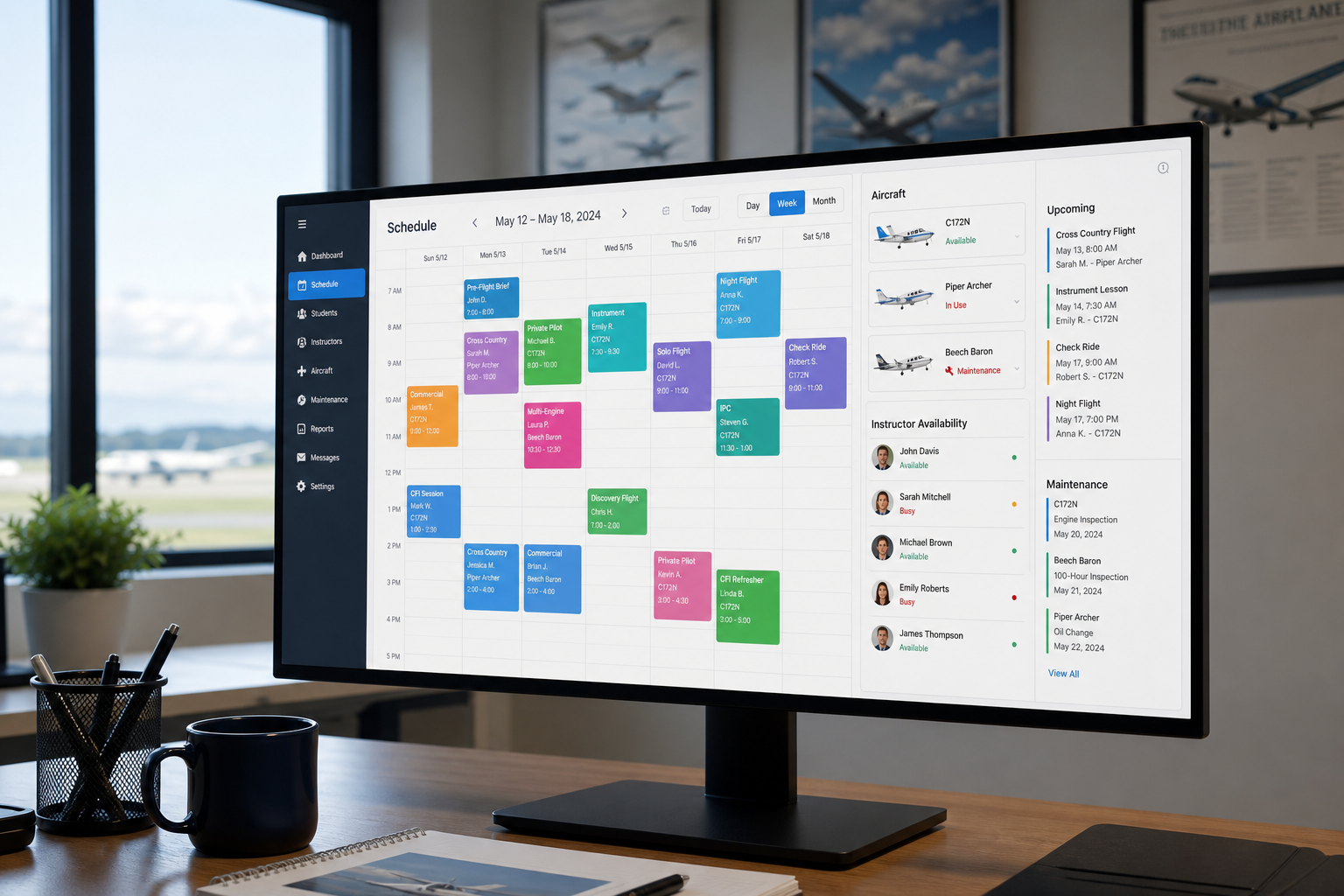
Scheduling is the operational backbone of every flight school.
Leading schools manage:
- Aircraft scheduling
- Instructor availability
- Student bookings
- Simulator resources
- Maintenance planning
from one centralized platform.
Why It Improves Efficiency
Administrators spend less time coordinating schedules while reducing booking conflicts.
2. Improve Instructor Utilization
Instructor time is one of a flight school's most valuable resources.
Schools improve utilization by:
- Balancing workloads
- Matching instructors to student training stages
- Reducing idle time
- Standardizing scheduling
Why It Improves Efficiency
More instructional hours are spent flying rather than coordinating schedules.
3. Maximize Aircraft Availability
Aircraft only generate value when they are flying.
Efficient schools coordinate:
- Scheduled maintenance
- Inspections
- Aircraft availability
- Daily flight operations
within one operational workflow.
Why It Improves Efficiency
Improves fleet utilization while reducing unexpected cancellations.
4. Standardize Training Workflows
Operational inconsistency creates unnecessary administration.
Leading schools standardize:
- Lesson documentation
- Instructor sign-offs
- Student evaluations
- Training milestones
Why It Improves Efficiency
Less duplicate work and more consistent training delivery.
5. Improve Operational Visibility
Administrators should always know:
- Which students are behind schedule
- Which instructors have availability
- Which aircraft are unavailable
- Where operational bottlenecks exist
Why It Improves Efficiency
Real-time visibility allows schools to solve problems before they affect training.
6. Automate Repetitive Administrative Tasks
Many administrative tasks don't require manual work.
Examples include:
- Scheduling notifications
- Student reminders
- Instructor alerts
- Operational reporting
- Compliance documentation
Why It Improves Efficiency
Automation reduces repetitive work while improving consistency.
7. Manage Operations From One Platform
The most efficient flight schools avoid disconnected systems.
Instead, they connect:
- Scheduling
- Student progress
- Instructor management
- Aircraft availability
- Maintenance visibility
- Compliance records
- Operational reporting
within one flight school management platform.
Why It Improves Efficiency
Connected operations reduce administrative complexity while improving communication across the organization.
How to Improve Flight School Efficiency
The highest-performing flight schools typically focus on five areas:
- Centralize scheduling
- Improve aircraft utilization
- Increase instructor productivity
- Standardize operational workflows
- Automate administrative processes
Together, these improvements increase training capacity without requiring additional administrative resources.
Flight School Management Software Compared
Several platforms help flight schools improve operational efficiency through scheduling, automation, and centralized management.
| Platform | Best For | Scheduling | Operational Visibility | Automation | Multi-Location |
| FlightLogger | Unified flight school operations | ⭐⭐⭐⭐⭐ | ⭐⭐⭐⭐⭐ | ⭐⭐⭐⭐⭐ | ⭐⭐⭐⭐⭐ |
| Flight Schedule Pro | Established flight schools | ⭐⭐⭐⭐⭐ | ⭐⭐⭐⭐ | ⭐⭐⭐⭐ | ⭐⭐⭐⭐⭐ |
| Aviatize | Compliance-focused organizations | ⭐⭐⭐⭐ | ⭐⭐⭐⭐ | ⭐⭐⭐⭐ | ⭐⭐⭐⭐⭐ |
| Flight Circle | Small and growing schools | ⭐⭐⭐⭐ | ⭐⭐⭐⭐ | ⭐⭐⭐⭐ | ⭐⭐⭐⭐ |
| Talon Systems | Enterprise aviation organizations | ⭐⭐⭐ | ⭐⭐⭐⭐ | ⭐⭐⭐⭐ | ⭐⭐⭐⭐ |
| Private Radar | Smaller flight operations | ⭐⭐⭐ | ⭐⭐⭐ | ⭐⭐⭐ | ⭐⭐ |
Capabilities are based on publicly available information and should be verified with each vendor.
Which Platform Is Best for Operational Efficiency?
Every platform listed above can improve flight school operations, but they focus on different priorities.
Choose FlightLogger if you want:
- Centralized scheduling
- Student progress tracking
- Maintenance coordination
- Compliance management
- Operational dashboards
- Multi-location management
Choose Flight Schedule Pro if you want:
- Mature scheduling capabilities
- Broad industry adoption
- Strong resource planning
Choose Aviatize if you want:
- Compliance-focused workflows
- Operational standardization
- Structured validation processes
Choose Flight Circle if you want:
- A user-friendly platform
- Straightforward scheduling
- A solution designed for growing schools
Choose Talon Systems if you want:
- Enterprise operational management
- Large-scale aviation administration
Choose Private Radar if you want:
- Operational tools for smaller aviation organizations
Frequently Asked Questions
How do you improve flight school efficiency?
Flight schools improve efficiency by centralizing scheduling, increasing instructor and aircraft utilization, standardizing training workflows, automating administrative tasks, and improving operational visibility.
What is the biggest cause of inefficiency in flight schools?
The most common causes include disconnected systems, manual scheduling, duplicate data entry, inconsistent documentation, and limited visibility into aircraft, instructors, and student progress.
How can flight schools increase instructor utilization?
By balancing instructor workloads, matching instructors to training stages, reducing scheduling gaps, and managing availability through centralized scheduling software.
How can flight schools improve aircraft availability?
Aircraft availability improves when maintenance planning, inspections, and scheduling are managed together rather than in separate systems.
What software helps improve flight school efficiency?
Leading flight school management platforms include FlightLogger, Flight Schedule Pro, Aviatize, Flight Circle, Talon Systems, and Private Radar. The right choice depends on operational complexity, growth plans, and compliance requirements.
Final Thoughts
Operational efficiency isn't achieved by working harder—it's achieved by working smarter. Flight schools that centralize scheduling, improve instructor and aircraft utilization, standardize training workflows, and automate repetitive administrative tasks can increase training capacity without significantly increasing overhead. By choosing the right flight school management software, growing academies can build more efficient, scalable operations while delivering a better experience for students, instructors, and administrators.